
Overview:
- Medusa’s myth shows how society punishes women who survive violence.
- Ancient victim-blaming patterns echo in modern media and digital culture.
- Women who assert their power are rendered monstrous through Medusa Image.
- Reclaiming Medusa empowers survivors and challenges dominant patriarchal structures.
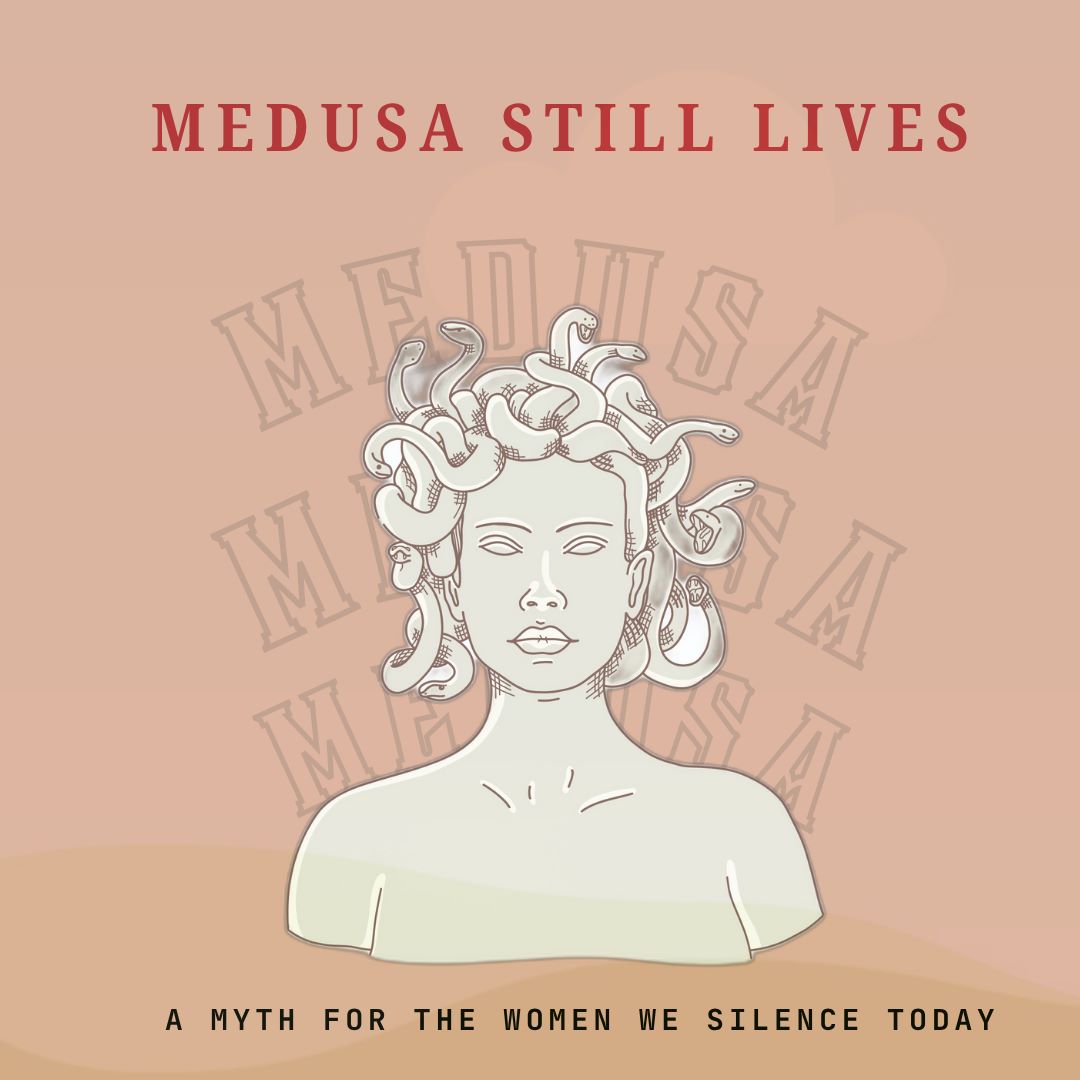
The age-old myth of Medusa is often seen as a tale of monstrosity. A creature who had living snakes as hair and looked so hideous that her gaze could turn anyone into stone. But what if we have been reading it wrong all these years? What if Medusa was never the monster, but rather the mirror and a symbol of feminism? Medusa‘s story still lives on in society today, as women are silenced and shamed for speaking out.
Medusa‘s myth transcends its genesis as an older tale, it is a metaphor for the misogyny transgressing today.

Medusa’s Myth: From Victim to Monster
For hundreds of years, Medusa’s legacy was remembered not as a woman who had been wronged, but rather, a monster to be feared.
But what if her transformation was never a punishment—only a shift in power?
The Origin Story
Originally a mortal priestess dedicated to the temple of Athena, Medusa was deemed beautiful. She had a life-changing misfortune when Poseidon raped her within the sacred grounds. Instead of punishing the god, Athena cursed her devotee. She turned Medusa into a Gorgon with hair replaced by snakes. A petrifying gaze that could turn anyone into stone.
Punished, Not Protected
Transforming Medusa wasn’t justice; it was victim blaming in mythologized form. Her beauty and humanity, all stripped away and replaced by an abominable symbol of shame and silence. The worst part was that it was Athena, a woman who punished her. It illustrates exactly how a woman can also perpetuate the values of a patriarchal system. The myth narrates how these power systems keep women from uniting and make their solidarity turn into silence.
A Symbolic Transformation
Medusa’s curse symbolizes how a woman’s suffering is manipulated by patriarchy. She was made a monster from a victim. Her image was used to silence the voices of survivors of violence. Her myth is a cyclical narrative. No one remembers or acknowledges the excuses made for the actions of the perpetrators. Instead victims are blamed and demonized.

Silencing Women: Ancient Patterns, Modern Echoes
There has always been an inclination in history to punish women who speak out. The methods range from myths to present-day media and technology, yet the pattern remains. Medusa’s tale continues, just in different formats.
Witch Hunts to Hashtags
The age-old tactic of converting survivors into instruments of terror did not die with Medusa; it simply evolved. From a world of witch hunts to viral hashtags, we continue to police and punish women who condemn silence. Confrontational women were accused of being witches during the witch hunts. Now, those same female rebels are confronted with public headlines, online cyberbullying and public shaming.When Medusa finally faced Perseus, she didn’t cower or plead, she met him head on. That confrontation still echoes today. You are still treated as a threat if you challenge the power structures—a contemporary Medusa.
Hillary Clinton’s 2016 campaign demonstrated this. Memes depicted her with snake hair and demonic eyes, echoing the myth to describe her as menacing just for wanting power.

Labelling the Loud
The pattern didn’t end with politics, it grew stronger during revolutions such as #MeToo. Women who spoke out against their abusers were villainized. Amber Heard faced public outrage echoing the long history of vilifying women who speak out against power. Rhea Chakraborty had to face the worst media trial, being called a “witch” for allegedly “corrupting” and “destroying” a man. Across cultures, the Medusa myth is used to terrorize women who challenge male power, casting survivors as threats.
The Modern Demonization of Female
The prevailing imagery of Medusa illustrates how ancient mythologies are repurposed today to hurt women in the digital era. Nancy Pelosi was frequently represented in memes and political cartoons with snake-like hair. She was cast as Medusa, symbolizing how society sees powerful women as threats. Even feminist thinker Camille Paglia, in Sexual Personae, criticizes victim-centered feminism for reducing real issues to myth-based fear.

Reclaiming Medusa: A Feminist Reawakening
Today, Medusa’s story is being reclaimed. She is not a tale of terror, but a symbol of feminine strength and survival.
A New Symbol of Power
Medusa plays an ongoing role in the shaming of women, so reclaiming her image asserts power. Today, Medusa has become a feminist symbol. A few artists and writers depict her as a survivor. Making Medusa a symbol of female anger, resistance, and endurance. Medusa with the Head of Perseus, by Luciano Garbati, subverts the myth. The sculpture shows Medusa holding the severed head of Perseus and was heavily popularized during the #MeToo campaign. Recently poet Nikita Gill refers to Medusa in her book, Great Goddesses, as part of a new way to think about her. She reimagines Medusa as a protector. Medusa is now no longer the monster; she is the metaphor of a system terrified of powerful women.
When Rage is Righteous
Consequently, this bold reinterpretation sheds light on an emotion at the heart of Medusa’s tale and many women’s lives today: anger. People often brush women’s anger as crazy, risky, or irrational. Society tends to term it hysteria instead of hearing it as a cry against injustice. But Medusa‘s wrath was not for nothing, nor was it futile. Her rage came from a sense of injustice.
Today, the same rage powers feminist activism and calls against injustice tolerated by women across the globe. Women are using their rage to fight against entrenched power. From #MeToo to protest against gender-based violence, there is a demand for meaningful change in the system.

Medusa is Every Woman
Medusa lives on, in every woman who has been forced into silence or shamed for telling her truth. It’s time we put an end to transforming women into Medusas and begin to hear them out. When we listen, we don’t just change the narrative; we change society and culture.
Conclusion:
The Medusa tale is more than a myth; it reveals how power silences and distorts facts. Yet, the tale also brings hope. Just as we can rewrite myths, we can reshape cultural stories. By reclaiming Medusa, we reclaim every hushed voice, every woman turned hard as a rock by society’s gaze.
Medusa lives on, but so do we. And we no longer fear speaking up.
