
CATEGORIES
Entrepreneurship | Leadership and Networking | People We AdmireOverview:
- Launching a company can come with unexpected challenges that may require trial and error to navigate operations and leadership effectively.
- The Venned Group’s strength lies in making the “intangible” measurable. The organization helps teams develop clarity, emotional intelligence, and leadership from within.
- Kendra Johnson shifted her definition of success from traditional markers to prioritizing joy, health, and time with loved ones.
1.Could you tell us a bit about your childhood, and if you think it shaped you in any way to the person you are today?
I grew up in Canada as an only child, and I watched my parents, both entrepreneurs, consistently work hard, grow, and contribute to the communities around them. My mom took on more of the personal growth path. To date, she has helped tens of thousands of people, a metric that I quietly strive to reach, to do her legacy justice, and she is still amazing, by the way!
Being raised by two entrepreneurial parents meant that I was always exposed to different ways of doing things to achieve my goals. It really showed me what was possible beyond the traditional 9-to-5. However, as a teenager, I did not want to do what my parents did. Instead, I wanted a more conventional path and chose to study biology with the hopes of becoming a marine biologist. I studied science all through high school and into university. Then, during my first year of university, I had a moment of clarity: this was not meant for me. I loved science as a hobby, but my true passion lay with people. I was fascinated by what drives them, what connects them, and how I could help bridge gaps and get them on the same page. I realized I wanted to be that point of connection (and that I was good at it!).
I remember the day I told my parents this. I was in tears. It was midway through my first semester at university, and I just said, “I don’t want to do science anymore”. My mom responded with a story about when I was 5 years old and I stood on the playground with two friends who were not getting along. She said I stood there with my hands on my hips and said, ‘I just don’t understand why we all can’t get along.’ She said she had known this day was coming since she saw me bridge the gap between those two girls way back. She had simply let me figure it out on my own. Entrepreneurship and being in the people development space were inevitable. It just took me about 19 years to realize it.
2. As the founder of The Venned Group, what were some of the biggest challenges that you faced in establishing the company, and what aspects came more easily?
Some of the challenges I faced stemmed from figuring things out on my own, despite having entrepreneurial parents. Times had changed, and by the time I was starting my business, they were nearing retirement. I had to navigate everything from how the business world works now to basics like filing business taxes. There is no playbook when you are starting out, as no one tells you the exact steps. I learned through trial and error, from mapping the client journey and business operation to structuring invoices and knowing who to hire. I also had to learn when to lead and when to step back, something I’m still mastering as The Venned Group evolves. Often, I didn’t know what I didn’t know until I learned the hard way. Now, I openly share those lessons on social media to help other leaders and new business owners avoid the same pitfalls I encountered.
What came naturally was building connections with clients who were ready to partner. Many of them have stayed with us for years, and those lasting relationships have made consistent change possible. Designing programs through a soft-skills lens and turning intangibles into something tangible, learnable, and measurable was also intuitive. It’s the core reason I started The Venned Group. I saw a gap: people understood the value of soft skills, but did not know how to build them in actionable ways. I wanted to translate those abstract concepts into structured steps that lead to real behaviour and habit change for both individuals and organizations, but most specifically, for middle managers – a group that is considerably overlooked.
3. What inspired you to pursue this career?
I started The Venned Group inspired by my journey of figuring out what I wanted to do and creating my path. After studying marketing at university, I shifted into project management and corporate event planning, where I frequently engaged with large companies, celebrities and local businesses.. Our team became a hub, connecting many sectors, and in that space, I noticed how middle managers, despite being highly competent, were stretched thin and lacked the soft skills needed to lead effectively. No one had taught them, or me, how to delegate or manage performance. Throughout this time, I made the classic error of burning out and took some time to travel, work in a different industry & reset. While travelling and working odd jobs, this gap and the need for middle managers to be supported became even clearer to me. People needed support to enhance their technical skills, and enhancing their soft skills was the solution. It also meant helping to avoid burnout, like I experienced. After years of research, reflection, and refinement, I developed a proprietary assessment and program, called S.P.A.R.K., that eventually laid the foundation for The Venned Group.
4. Who were your mentors and role models during this journey?
I’m fortunate to have a roster of mentors that I’ve been able to integrate into my patchwork. Of course, my parents are two of them. Besides my parents, one of my best mentors was a gentleman by the name of Steven. I’m not sure he even knows this! He saw a lot of potential in me during my event planning career. He helped me understand what a client’s success journey looks like. He invested a lot of time in me and our team to help us raise the bar on our performance expectations and understand what consistent excellence looks like across the board.
Another person who stands out is a person I met in 2020 on LinkedIn. His name is Junior Taylor, and he has since then, become almost part of the family. He has held a mirror up to a lot of the growth that I’ve had. When I was in the early, figuring-out stage of my business, he was one of my first calls. Whether I was in tears or laughing hysterically, he always entertained my (sometimes totally irrational) conversations. Rather than telling me what to do, he would ask me what I thought I should do. He has really helped contribute to a lot of my growth. To this day, he still is a mentor and a friend.
5. DEI can sometimes feel like a checkbox. How do you ensure it becomes a mindset embedded into culture?
DEI is often treated like a checkbox, but at The Venned Group, we approach it through early and ongoing conversations about inclusivity and language. Rather than isolating DEI into a single module, we integrate it throughout all of the conversations. We encourage participants to ask: What would this look like from another perspective? Do we have all voices at the table? If not, what are we missing?
When we look at the different experiences that we bring into the workplace, they all look different. No two ‘microcultures’ (as we call them) are the same. We help people define what their microculture looks like and means, and in doing so, we create space to embed DEI into the fabric of the work. This means that it’s no longer a checkbox exercise, but it becomes a pattern and something that people are consistently acknowledging.
6. You’ve likely impacted countless lives through your work. Is there a particular moment of impact that stands out to you?
While working with a team, I had a quick one-on-one with a member who had been quiet during group sessions. He loved his work but saw himself as “just the video guy.” As we unpacked the process, he realized his videos were central to sales and marketing, helping clients connect with the company’s mission and ultimately driving business. That realization of his role and the major part it played in the organization shifted his whole perspective and drive to show up every day.
The following week, we had a group session, and he was far more vocal. All it took was him seeing that he wasn’t just a cog in the wheel but that he was an integral member of that team. Had we not had that conversation and had he not had that moment of reckoning for himself, he would have continued to fly under the radar. It was a really special moment just to see him step into his own and just take ownership of his skills and then for his team to recognize him for those skills – something they hadn’t openly shared with him before.
7. Based on your years of experience supporting people to be more effective communicators. What would you say is the most important thing to consider to communicate with clarity?
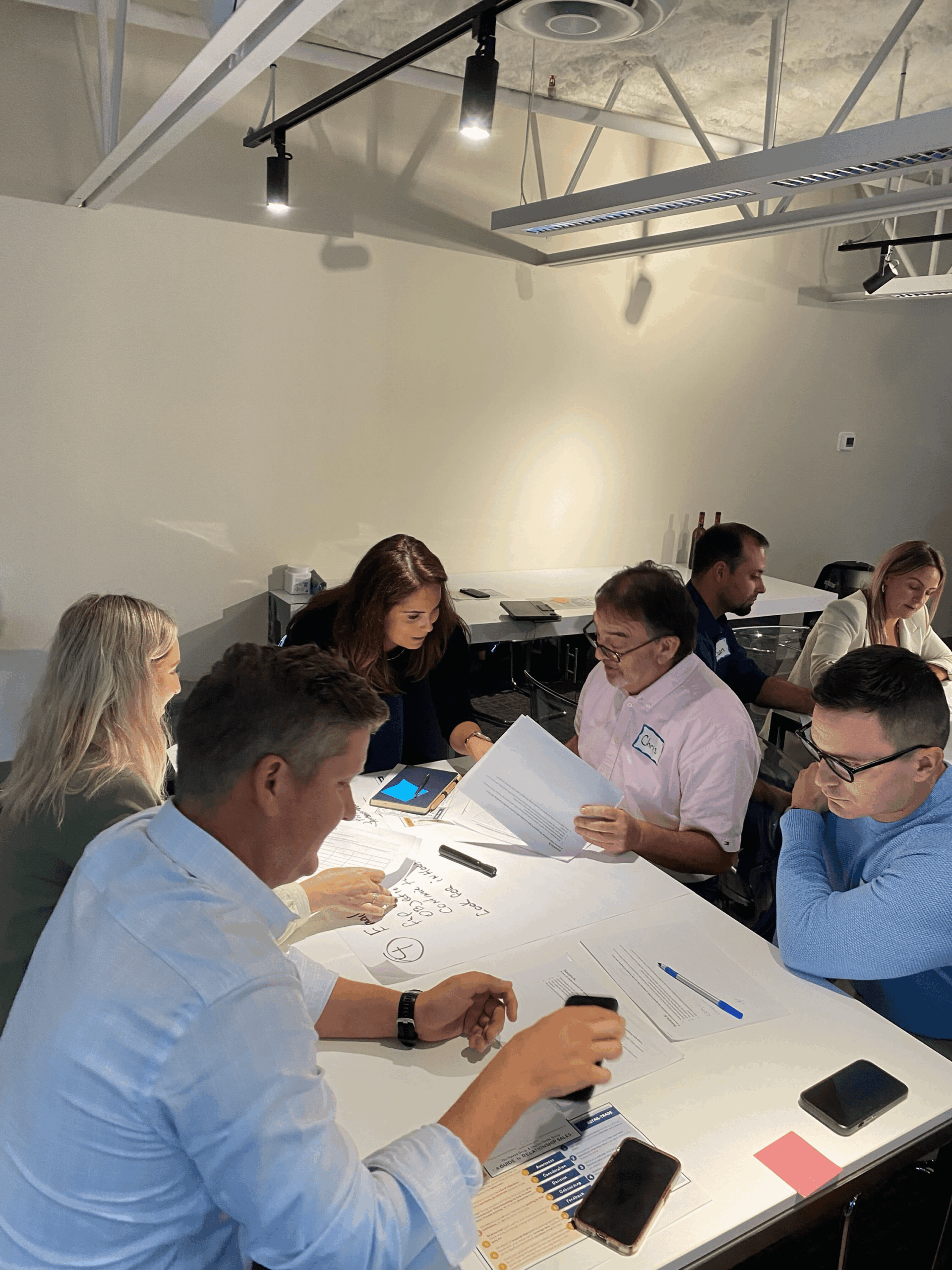
I’ll share an acronym we use with teams, which is helpful in understanding who you’re communicating with and what matters to them. When we talk about communicating with clarity, it’s really understanding who’s on the other side of the conversation and taking into consideration what the driving factor is for them.We teach a proprietary framework called T.A.C.T.
T is for Tailor your message. Who are you speaking to? What do they care about? And what are their priorities?
A is for Articulate it. Can you sum up in one sentence the main point of what you need them to know? If not, try again. Especially with middle managers who are managing up, it‘s important that they get that message across as quickly as possible with clarity. If you can distill it down to one sentence and then provide the rest of the context after, you’ll be in great shape.
C is for Channel. And I find that this one, especially in this day and age, gets really tricky. Some teams will use “Teams”, some will use email, some will pick up the phone, and others will text. We look at what is the most useful and the most appropriate channel for you to share this information with the other person. We work with teams on aligning this piece in particular, as a lot of information gets missed when proper channels aren’t used!
T is for Test for understanding. And that doesn’t mean asking, “Okay, so did you get that?” because that can come off as condescending and nobody likes that. Instead, we say, “Are we aligned? “Is that what you had in mind?”
Making sure that there’s clarity of understanding helps to alleviate what we call the communication volleyball. Where you have to go back and forth with clarifying questions. Testing upfront means everybody’s on the same page, and this limits the number of back-and-forths you’ll need to have.
8. As a soft skills expert, what in your opinion, is the most misunderstood aspect of soft skills in workspaces?
A common misconception is that soft skills training is only needed when things are broken. In reality, the best teams start with a solid foundation. I often compare it to going to the gym: you don’t go after breaking your arm, you go to prevent it. Soft skill development should be a continuous, proactive practice for all leaders and workplaces.
Another common myth is that soft skills can’t be taught, that you either have them or you don’t. While that belief is slowly shifting, it still persists. In reality, soft skills are absolutely trainable and measurable. They just take longer to develop because you’re changing habits and behaviours. Progress may be gradual, especially in today’s hybrid, global environments, but with the right tracking, it becomes clearly visible.
9. Your work centres on authentic communication and connection, often shaped long before we enter leadership roles. Is there a trait or value you’ve carried with you throughout your life that still guides how you lead today?
A skill that I’ve carried with me and one of the reasons I’ve been successful in the past in building teams and getting work done quickly is understanding who’s on the other side of the messaging. You need to understand what they care about and observe the things they say and constantly reference. This means you can find that point of resonance to build rapport quickly. You can think about it as a Venn diagram, which is part of what inspired the name The Venned Group. It is about finding that point of resonance in making that connection with someone else- a point where you have a mutual interest or a mutual experience which serves as a starting point to build on that relationship.
That connection is something that I have held very dear as it is a way to get things done quicker, but much deeper, and build lasting relationships with people. At the end of the day, as humans, we always have one point of connection that will be similar no matter what. The question remains, “What does that look like and how do we build off of that?” We at least have an understanding of one another, and we can start from there. To summarize the skill, it would be the power of observation. It is the ability to see people and hear what people care about , then finding a way to make that meaningful for them in my interactions. This kind of interaction is created through asking questions, learning more about them, and then building on the relationship.

10. How has your definition of success evolved from your early career to now?
When I was younger, I defined success as having a big team, wealth, a house, and a family—the “classic Canadian dream” some might say. But I never fully subscribed to that, which created a misalignment between what I thought success should look like and what it actually means to me. In the last 10 years, I’ve redefined success by doing what actually matters to me. It’s my family, my partner and our growing family, plus our ambitions. I don’t want to work myself into the ground. I want experience over things, freedom and time. I also want good health, and this means taking care of myself. I no longer believe in working myself into the ground just to earn more. I have redefined success as where I am happiest. Sometimes I feel that misalignment between my new definition of success and what I thought was success, as I’m chasing different goals and milestones. That definition changes over time, but happiness in whatever form is success to me.
11. What’re your hobbies outside of work?
I didn’t have hobbies for a couple of years, and that was a real problem. Work had taken over, especially during the pandemic. When things opened up, I realized that I needed to change. I’m a huge reader. I like suspense, crime, and thrillers. It’s something that allows me to just totally dive in and be in a different world and get my brain thinking differently. I also love to solve puzzles. I’m a nerd at heart. Every Christmas, we get a new puzzle, and solving it is an amazing winter activity.
I love to stay active with workout classes, yoga, and occasionally try new sports – golf has recently become a big hobby of mine. I used to love dance and basketball and hope to revisit them one day. Overall, my hobbies are about exploring new experiences, travelling, and keeping both my body and mind engaged.

12. Do you have a mantra or quote that keeps you going?
One really comes to mind, and I actually have it tattooed on my foot. It was a time when I was in the thick of being in a corporate environment. I was trying to make a name for myself, trying to impress, and I was getting so hung up on all the little details, the insignificant things that don’t really matter. I remember asking myself constantly, ‘What’s the big picture (which is my tattoo)?’ I always come back to the big picture because it’s easy to get sucked into the small things.
13. If you could suggest a book to us, what would it be?
One is Shantram if you want an amazing story. It’s a thick book, but it’s brilliant. I would highly recommend it. The second book is Stolen Focus. It is a good one for the world these days.
I’m currently reading The Psychology of Money, which is very interesting. It gets you thinking not just how to manage money but the behaviours and patterns that cause us to either keep or develop wealth or not. I would also recommend any book by Gilly Macmillan. She is, in my opinion, the thriller queen.
Conclusion:
Kendra Johnson’s transformation from an observant kid on the playground to the creator of a people-first business is proof that soft skills build great teams. Her journey echoes the value of active listening, genuine leadership, and respecting soft skills. Through her success, it is evident that connection-based leadership benefits everyone and not just businesses.
