
Overview:
- The idea of flow is responsible for the phenomenon of time vanishing under deep concentration.
- Flow’s state has many advantages, which include enhancement in pleasure and contentment, no matter how hard the task is.
- To get into the flow, one needs to have clear goals, instant feedback, and a perfect match of skills with the challenges.
- Flow can be integrated into work and hobbies for more rewarding experiences.
- Being present can help unlock flow more easily.
Introduction: Understanding Flow
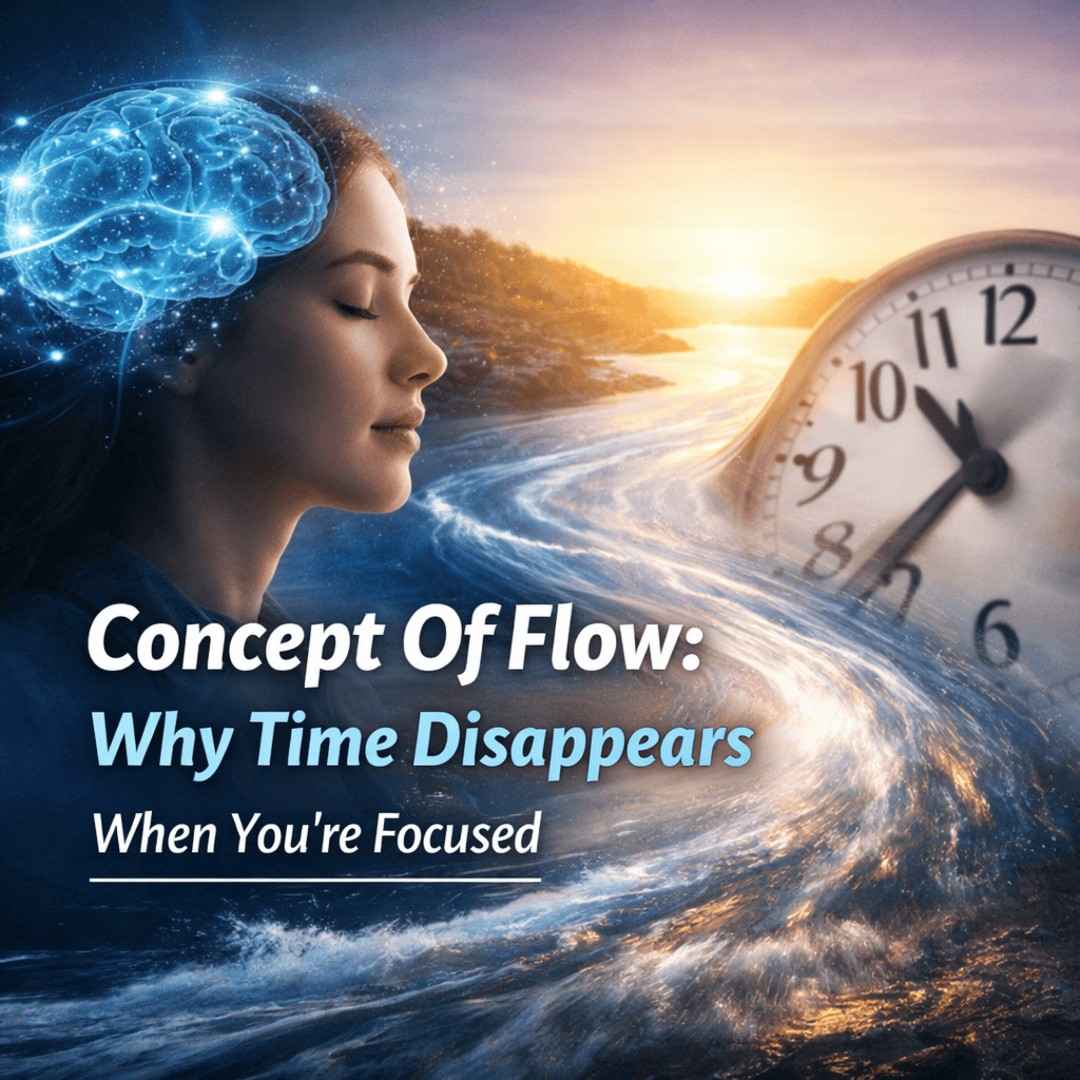
The flow state is a powerful mental condition where one becomes fully immersed in an activity. In flow, our conscious mind narrows to the present task. Psychologist Mihály Csíkszentmihályi describes flow as a state of “complete absorption” where “time vanishes,” and self-awareness fades into the background. In flow, all distractions disappear as a river steadily carries us forward, encouraging surrender to life’s natural rhythm. Total immersion quiets the inner critic, allowing us to flow and create significantly in what feels like a brief moment.
To be in the flow, our mind has to reach full concentration. In this heightened state, action and awareness merge, and our usual self-doubts vanish: Our brain’s default mode quiets, making us unaware of time passing, as minutes can easily slip into hours. In effect, flow becomes a “time machine” – when we emerge, we realise that what felt like minutes was actually much longer. The result is a deep sense of satisfaction: work becomes intrinsically rewarding, and effort feels almost effortless.

Gentle Beginnings of Engagement
Newcomers often experience flow during simple activities because these tasks feel easy and familiar.
Low difficulty reduces pressure, allowing the mind to relax and attention to settle naturally.
Artists focus on each brush movement, staying engaged with colour, shape, and motion.
As focus deepens, awareness of time fades, and minutes pass unnoticed.
Children drawing remain absorbed in imagination, giving the activity their full attention.
Writers begin with small ideas, while musicians repeat familiar patterns and rhythms.
These actions reduce mental effort and keep the brain focused without strain.
In such moments, attention stays steady, and the mind feels safe and engaged.
Over time, these early experiences build confidence and form the foundation for mastering flow.
Challenges: The Rapids of Deep Focus
Complex tasks often increase deep focus because they demand sustained attention and reduce mental wandering.
Deadlines, puzzles, and problem-solving narrow the mind toward one clear objective.
When challenge matches skill, focus strengthens, and the task feels demanding but manageable.
Tasks that feel too easy invite distraction, while overwhelming tasks trigger stress and break focus.
Balanced difficulty keeps the brain engaged, which causes time to pass unnoticed.
Clear goals reduce confusion and help maintain a sense of control during work.
Distraction-free environments protect attention and support sustained concentration.
Short breaks restore mental energy and help focus return stronger.
Each obstacle builds skill over time, turning effort into growth and resilience.
Creating Focus in Simple Tasks
Simple tasks can promote deep focus when approached with intention and clarity. When a task feels achievable, the mind relaxes, allowing attention to settle naturally. The establishment of minor objectives and deadlines increases the level of engagement without creating stress. Dividing the task into smaller sections lessens mental strain and keeps the flow. Doing the same thing over and over again establishes a beat that aids the brain in being more attentive for a longer time. Attention becomes clearer when our objectives are in line with our abilities, and thus, neither boredom nor anger occurs. By cutting off distractions, one can have their focus intact and they will keep going. Feedback at intervals serves to point out the gains made and to stimulate the effort put in. The more one practices the steadiness of focus, the more even simple tasks can take one to the state of flow.

Neurological Secrets: Why Time Disappears
Flow state changes brain activity and chemistry, supporting motivation and sustained attention.
There is an elevation in dopamine during flow, and this heightens engagement and rewards focus at the same time.
The norepinephrine helps us to focus and keeps our brain active during this process. It acts on the prefrontal cortex, thus making it less active, which in turn limits self-doubt and overthinking. When we are less self-aware, the brain also becomes less aware of the time passing. Flow experience happens when our brains reduce certain activity, which brain scans have shown. During this time, hours can feel like just minutes. The river metaphor works well here, as being fully immersed helps us move past our mental barriers. When we focus deeply, we lose track of time, and it fades away naturally.
Benefits and Real-World Applications
The flow state can hugely advantage and enhance quality of work in the whole range of fields. Creatives excel and athletes perform best when fully focused and absorbed in their work.Csikszentmihályi’s research shows that flow fosters happiness, combats burnout, and adds meaning to daily chores.
Legal representatives create clearer outcomes, while researchers delve deeper into problems, often leading to breakthroughs. Business administrators enhance decision-making through collaborative flow, leading to increased innovation and cooperation among teams. In a nutshell, flow is applicable in any domain where concentration, talent, and meaning come together.

Overcoming Barriers to Flow State
Notifications and multitasking easily break deep focus, so single-task habits are essential.
Stress and fatigue make flow harder to reach, making sleep and mindfulness important.
Perfectionism can block progress, while self-acceptance helps maintain steady focus.
Small, consistent steps work better than occasional effort. Daily audits of distractions keep attention clear.
Short meditation sessions, rigidly scheduled focus blocks, and nature breaks help restore concentration.
By practising persistence and managing mental and environmental obstacles, flow can be reliably accessed.
Lessons from Flow State
Flow can be cultivated intentionally by starting with small, daily practices and observing personal triggers.
Patience helps navigate obstacles, while surrendering to deep focus allows time to fade naturally.
Put immersion above just being busy, and take on challenges that are equal to your skills.
Rejoice in every flow session, however little it may be, and make your ways public for others to benefit from.
By regular practice, normal activities can turn into exceptional ones, and work can be perceived as more significant and gratifying.
Conclusion
Mastering flow leads to deep focus where time seems to disappear.
Understanding triggers and lessons from flow can guide consistent high performance.
Daily practice, when coupled with immersion and focus, has the potential to increase productivity, creativity and happiness in general.
Get in the flow of focus and let the actions of doing significant work change mundane tasks into gratifying victories.
