
CATEGORIES
#`Marketing & Branding #Business #CareersOverview:
- Emerging markets will drive most global consumption growth over the next decade.
- The next billion consumers demand affordability without compromising dignity or quality.
- Context-aware design matters more than advanced technology.
- Inclusion, trust, and accessibility determine long-term product adoption.
The next generation of consumers worldwide will not originate from the markets of saturated cities. Rather, they will originate from smaller towns, rural areas, and rapidly growing metropolitan areas in Asia, Africa, and Latin America. These new consumers carry with them the hopes and ambitions that have been associated with the concept of “economic mobility”
However, developing products and services for these consumers is not as simple as taking away features or lowering prices. Creating products and services for these consumers requires a different approach. This approach must account for the real-world conditions they live in. Many face income instability and limited physical infrastructure. Cultural differences also influence their needs and behaviors. In addition, other real-world constraints shape how they access and use products and services.
Some companies view emerging markets as an extension of developed markets. However, this approach has often proven unsuccessful. Products that succeed in developed markets do not easily translate to emerging ones. Simply reducing product size rarely addresses local needs. Emerging markets require fundamentally different design and delivery strategies. Rather, successful products for emerging markets must be designed specifically for their contexts. They need to be created within specific constraints. These constraints are closely linked to the daily lives of the target consumers. Understanding these realities is essential for product success.
Designing for the next billion consumers requires a different focus. It is about creating clever and useful solutions to real-world problems. It is not about making ostentatious products. Nor is it about eye-catching marketing campaigns.
Who Are the Next Billion Consumers?
The coming billion consumers are purchasing formal goods and services for the first time. They are tech-savvy but frugal. Most nuance their aspiration for a better life with pragmatic decision-making.
And these consumers don’t act the same. Income, education, and consumption habits are all over the map. But they do share some realities. They are price-sensitive, have marginal access, and are deeply community-trusting. Unlike the typical consumer, they often judge a product by its long-term value, not its brand prestige. Reliability beats novelty. Familiarity beats experimentation.
So, brands can’t rely on stereotypes. They have to understand micro-segments and local behaviors.

Why Traditional Product Design Often Fails
Numerous offerings don’t make it in developing markets due to the presumption of reliable infrastructure. Reliable power, ample data, and access to formal retail are not guaranteed.
Besides, global solutions often leave out cultural practices. Packaging, consumption, and colors can marginalize users. A technologically advanced product can still be useless.
Another key problem lies in pricing. Monthly charges or large initial costs don’t attract low-income households. So, despite demand, adoption remains low
So, the root of failure is often mistaken belief, not poor delivery.

Affordability Without Compromising Dignity
Affordable does not mean cheap. Consumers want durable products, value, and respect, not just the lowest price tag. Products that do not meet these criteria typically will not build trust.
Many products classified as “low-end” have lower trust-building capacities. Thoughtful design choices allow for an affordable price point while maintaining a higher-quality perception.
In FMCG, single-use sachets drove mass adoption by making products affordable in smaller quantities. In the same way, shared mobility has alleviated ownership burdens while continuing to offer the same convenience.
Designing for Infrastructural Constraints
It is important to design products for unreliable infrastructure. These products must function despite an inconsistent power supply. They should operate with limited or no internet bandwidth. They must also work despite logistical constraints.
By utilizing offline and low-energy technologies and focusing on durability, products can be made much more usable. In addition to that, products must be able to withstand rough treatment and environmental stress.
Successful companies tend to test their products under real-world conditions and not in controlled lab environments. By doing this, companies receive feedback from local customers that enhances their practical designs.
Through this process, resilient design can provide companies with significant competitive advantages.
Cultural Relevance and Trust Building
Culture has a much more profound effect on how a person consumes than income alone. Consumers will accept products much faster as long as those products are associated with their habits, language, and cultural norms.
Trust plays an important role in product acceptance. Recommendations from local merchants and community leaders strongly influence buying decisions. Peer associations also shape consumer choices. Therefore, brand communication must feel familiar and respectful.
Educating customers about products and services is often necessary. This education should be delivered in their mother tongue. Instructions must be simple and unambiguous. Visual aids like pictures and drawings can significantly increase adoption rates.
Communities therefore anticipate that brands will demonstrate cultural sensitivity as a prerequisite rather than an afterthought to sales.
Technology as an Enabler, Not the Centerpiece
Technology is an enabler that helps solve “real” issues, not just a way to show off technological advances. In many instances, overengineering drives up the cost of products while not adding value to the consumer’s experience.
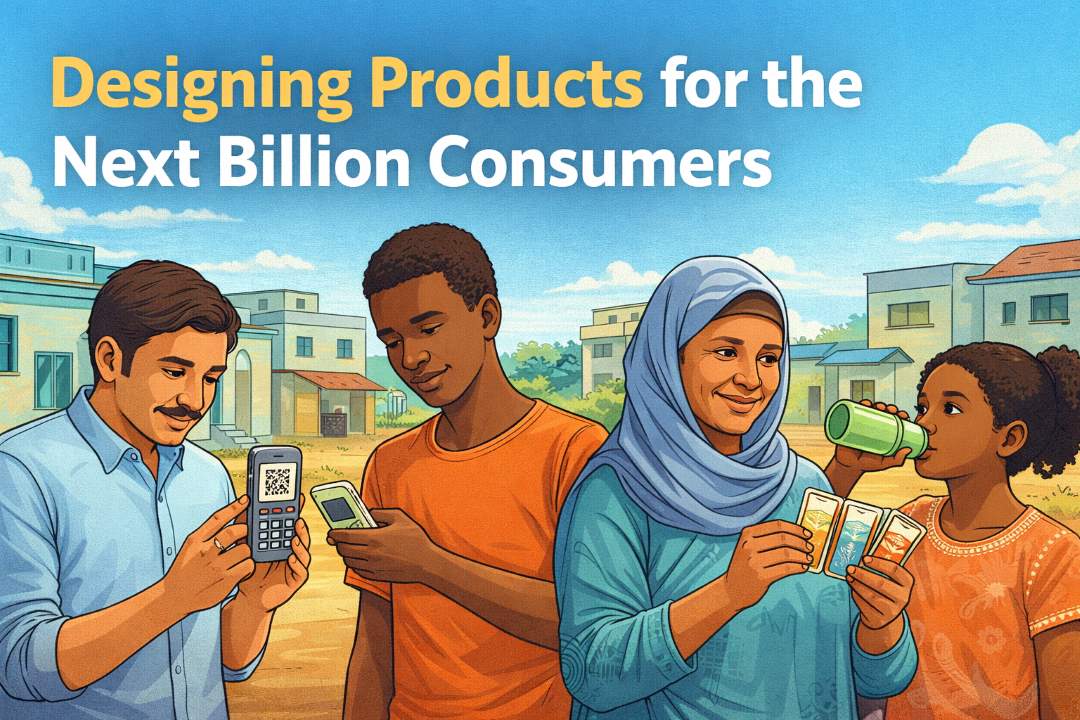
Many successful products creatively use existing technologies like missed calls, QR payments, and feature-phone compatibility.
The key to a successful technology adoption, therefore, is reducing friction. When new technology creates new complexities, consumers become reluctant to adopt it.
The most successful designs tend to create “invisible” technology and provide the consumers with improved results.
Building for Scale from Day One
Scalability is achieved via simplicity. Complex supply chains, excessive customization, or fragile components can limit a company’s ability to scale. Creating a standardised, flexible product allows for quick replication across different regions of the globe. Building partnerships with local distributors enhances a company’s ability to reach markets effectively.
Scalability must be embedded in cost structures to support lower margins at scale. A company’s profitability during growth will come from volume rather than premium pricing.
Conclusion
Designing products for the next billion consumers implies having humility, empathy, and an understanding of context. Growth will not come from exporting existing models. What works elsewhere may not work here. Growth comes from designing around the customer. It requires understanding their challenges and operating environment. If you listen properly and understand customers’ needs, you will be able to sustain scalable growth.
