
CATEGORIES
#Business & Economy #Social Impact #TechnologyOverview:
- Carbon markets face intense scrutiny regarding their true environmental impact today.
- Pricing mechanisms struggle to reflect the actual cost of global pollution.
- Transparency issues severely threaten the overall climate credibility of carbon offsets.
- Gender equality in leadership remains crucial for sustainable corporate climate policies.
Global efforts for reducing the carbon emissions have reached a critical juncture. International observers heavily monitor environmental responsibility management. Carbon markets in 2026 stand at the absolute center of this debate. Many experts wonder if these financial mechanisms truly heal the planet. Some critics argue they merely shuffle carbon guilt among corporations. Companies buy credits to offset their continued fossil fuel usage. This practice raises vital questions about actual environmental progress.
Analysts question if these systems drive genuine corporate change. Or are they just a complex accounting trick for heavy polluters? Understanding this evolution requires examining its precise theoretical underpinnings. The following analysis dissects the macro-economic forces currently reshaping market structures. The initial exploration focuses on how these systems attempt to price pollution. Ensuring strong climate credibility is paramount for long-term ecological success.

Image Credit: Gemini
The Mechanics of Carbon Pricing
To comprehend the carbon market, analysts must first examine the financial instruments driving it. These mechanisms attempt to quantify the cost of environmental degradation into actionable corporate expenses.
Cap-and-Trade Systems
The majority of nations use cap and trade systems for controlling industrial pollution. Firstly, the government will set a strict limit on how much greenhouse gas emissions can happen. Companies are then allotted or buy carbon credits based on their level of production annually. Companies which pollute less are able to sell their excess carbon credits. Therefore, there is an economic incentive to reduce carbon emissions.
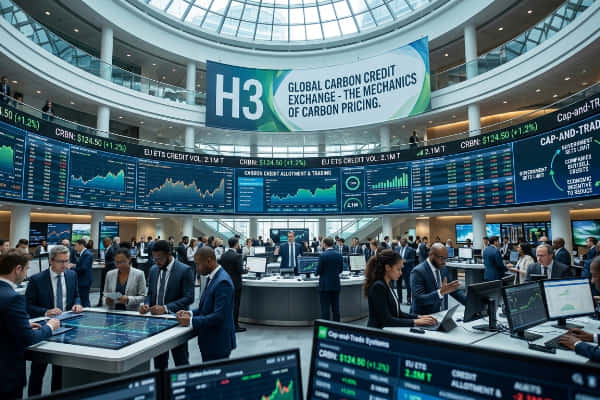
Image Credit: Gemini
Voluntary Carbon Markets
The process of voluntary carbon trading is entirely different from mandatory carbon emission regulations set by the authorities. For instance, corporations choose voluntarily to buy carbon credits to achieve their objectives of being sustainable. When a company eliminates one tonne of carbon dioxide, it earns one carbon credit. Carbon credits can be earned through initiatives such as tree planting and generating energy through renewable resources. Businesses use them to declare their carbon emissions neutral. Nevertheless, the absence of rigorous regulation leads to enormous variations in the market.
The Role of Technology
The use of modern technology plays a crucial role in monitoring carbon offsets. Blockchain technology acts as an online platform that records carbon credit transactions without any risk of fraud. Technology makes sure that double counting does not occur and that carbon emissions are reduced. Satellite images can be used to track global activities related to deforestation. These images are analyzed using artificial intelligence techniques to make sure that the claims made by the projects are true.

Image Credit: Gemini
Pricing Hurdles and Economic Realities
Although conceptually sound, carbon pricing suffers greatly in terms of practical economics. Market inefficiencies will always loom over the main objective of reducing emissions. The leap from theory to implementation within international markets is extremely difficult. Parties involved will have to navigate between making money and saving the environment.
Supply and Demand Imbalances
A functioning market requires accurate and stable asset pricing continuously. Even in 2026, carbon markets struggle with this concept. An oversupply of cheap, low-quality credits floods the current system. This depresses prices and removes the financial sting of polluting. When offsets cost pennies, companies will not change their operations. True innovation requires carbon prices reflecting actual environmental damage accurately. Cheap credits completely undermine the core philosophy of market-based environmentalism.
The Cost of Meaningful Action
Carbon sequestration efforts of high calibre cost much to set up and manage. Direct air capture technology entails large-scale financial investments at this moment. Ecological approaches require constant funding and monitoring. Consumers usually opt for the most economical credits possible because that saves on costs. Such a situation leaves truly effective programs underfunded. It is essential to reform mechanisms so that capital is allocated exclusively to initiatives with proven impact on climate mitigation.
Market Speculation
The players who have come to the carbon credit trading floor are financial speculators. They purchase carbon credits expecting that their total value would rise in the future. Such speculative activities raise the volatility in the environmental finance markets. Rapid fluctuations in prices increase the competition for environmentally-friendly projects. It is equally tough for companies to predict the cost of their future compliance.
Transparency and Climate Credibility
Without the element of trust, the financial market will always be very unstable, necessitating very strong control measures. The biggest challenge when it comes to ensuring the reliability of carbon offsets is the issue of verifying their authenticity.
Verifying True Impact
The integrity of any market relies on absolute data transparency. Unfortunately, carbon offsets often lack this highly essential characteristic today. Verifying the actual impact of a forest project is difficult. Trees might burn down, releasing the stored carbon back instantly. Sometimes, protected forests are never actually in danger of logging. This is known as additionality. If a project does not add new value, it fails. These verification failures severely damage overall climate credibility worldwide.
Combating Greenwashing
Both consumers and investors have become increasingly suspicious of companies’ sustainability statements. There is an expectation that organizations show evidence of reducing their emissions rather than simply making such statements. It does not make sense for an organization to buy cheap carbon offsets and still fund fossil fuel run projects. This is considered a case of greenwashing by many regulatory agencies, who are now beginning to act against such organizations. Organizations need to focus on carbon emission reduction rather than offsetting their carbon footprints.
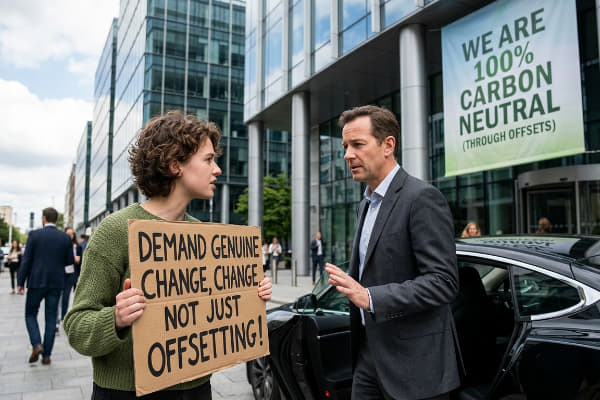
Image Credit: Gemini
Regulatory Frameworks
The international community is at present working on formulating stricter laws concerning carbon trading. The Paris Agreement details methods for regulating the international carbon trade. Article 6 intends to develop an integrated, transparent accounting system. There have been increasing efforts by governments to regulate the statements made by firms regarding their impact on the environment. In fact, government agencies are investigating misleading marketing schemes for products and services described as environmentally friendly.
Social Equity and Sustainable Cultures
Sustainable development cannot take place within a sphere that excludes social factors concerning human beings. This inclusion makes the benefits of the solution enjoyed by people at all levels.
Gender Equality in Policy
Climate change impacts the vulnerable sections of society across the world, which means climate solutions should consider the diverse social elements of humans. Gender equality plays a vital role in designing environmental policies for corporations. Women have proved to be efficient at the grass root level in sustainable activities in the developing countries. These inputs are essential for the development of resilient solutions. There is evidence in the research by the World Bank that women tend to invest in their families.
Empowering Local Communities
Any carbon offset schemes have to consider the interests of the indigenous people thoroughly. In many cases, carbon offset schemes lead to displacement of the local community without adequate compensation. This not only causes conflict within the society but also totally destroys the ethics of the project. Linking the local communities adds value to the project, not in monetary terms but for ever-lasting value. It taps into the energy of millions of people who nurture ecosystems.

Image Credit: Gemini
Sustainable Work Cultures
Sustainability in corporations goes beyond simply purchasing carbon credits through brokers. It consists of creating robust and ethical systems within the corporation every day. Promoting a culture of remote work helps considerably with this process as well. Companies should be concerned about mental health awareness amongst their employees. Eco-anxiety is fast becoming a big issue amongst employees amidst the looming climate crisis. Creating proper support systems ensures that a highly motivated workforce can always be achieved. Dealing with imposter syndrome enables employees to drive climate innovations.
Conclusion:
Carbon markets in 2026 face a critical turning point globally. They must evolve from cheap public relations tools into robust engines. Prioritizing strict transparency and actual climate credibility will determine ultimate success. With rigorous regulatory standards, these dynamic markets can aid environmental transitions.
