

Overview:
- Women across the world are silenced differently—brutally in Afghanistan and politely in corporate.
- In Afghanistan, Taliban laws have deprived women of basic rights by removing them from public life, education, healthcare, and media.
- Corporate culture subtly controls women through gendered roles, unequal pay, and biological bias.
- Despite different methods, the same patriarchal system designates women out of power and visibility.
- But women persist and fight back strongly and together.
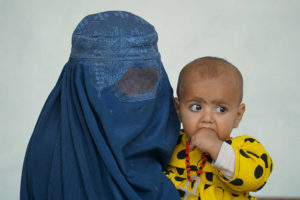
Patriarchy comes with the need to control- the worlds may be different but the story of women in every country is the same. A woman, covered from head to toe, with only her eyes visible through the net cloth, passes by a school she was not allowed to attend after Grade 6th, accompanied by her younger brother because she cannot leave her house without a male person. Another woman, in another space and country, is excited to share her ideas during the presentation she prepared staying up the whole night, but is “politely silenced” as her male colleagues talk over her during the strategy meeting, a reflection of how patriarchy manifests quietly within modern corporate culture.
The methods are different—one enforced brutally by law, the other shaped subtly by workplace culture. The severity is worlds apart, yet both reflect a shared reality: women across the globe are being muted in different tongues.

Kabul: Where Freedom Is a Crime
Since the Taliban took over Afghanistan from the democratically elected government in August 2021, women and girls have been deprived of their basic rights and participation in society. They do this in the guise of the “security” and “protection” of Afghan women but in reality take away the fundamental right of freedom.
Banned From Education, Work and Public Life
The Taliban have banned education for women and girls beyond 6th grade, forbid most kinds of employment, and barred them from many public spaces. This was not the end— the vice and virtue ministry published laws in August 2024 that banned women from talking in public places and having uncovered faces outside their homes. Social media rumours that the Taliban has also ordered patches to be made because “one eye is enough for women to see”. While unconfirmed, most are not surprised that such a norm is a part of the Taliban rule given their history.
Dismantled Human Rights and Removal of Legal Protections
According to the latest human rights report published by the UN Mission to the Country (UNAMA) in 2025, beauty salons run by women in their homes and women’s radio stations have been reportedly shut. One hospital was asked by authorities not to treat unaccompanied female patients.
In June 2025, the Taliban also removed legal protections for women, suspending the law on violence against women that protected them against rape and forced marriage.
Amidst global outrage, the International Criminal Court, recently issued arrest warrants for two senior Taliban leaders- Taliban’s supreme leader, Haibatullah Akhundzada, and Afghanistan’s Chief Justice, Abdul Hakim Haqqani, accusing them of crimes against humanity through the prosecution of women and girls. However, the Taliban condemned the warrants as an example of hostility towards Islam, calling it “nonsense”. “We neither recognise anything by the name of an international court nor do we consider ourselves bound by it,” said Zabihullah Mujahid, Taliban government’s spokesperson.
The situation in Afghanistan can only be described as gender apartheid. The Taliban officials are International Criminals. Women are being literally muted in Afghanistan and the world must not accept Kabul’s silence.
Corporate Culture: Control Disguised as “Politeness”
While the world watches Kabul in horror, a quieter silencing plays out daily in corporate spaces- less visible but deeply entrenched. Women are often controlled in the corporate culture of 2025 by being told to “play nice”. They are asked to collaborate (read compromise) with their peers and keep their voices down in meetings. This is a way of controlling and dictating how women should act, talk, and lead packaged into ‘progressive’ society.
The assertiveness of women leaders is mistaken for aggressiveness, their contributions are undervalued, and their potential for leadership is questioned. “If your team lead is a woman, you’re doomed, you can only chill when you have a male team lead” is the sentiment behind a reel trending on Instagram. Such comments make entertainment out of casual sexism further normalizing these skewed expectatations.
Equal Pay Is a Distant Dream for Most
According to the World Economic Forum’s report, while the gender pay gap has narrowed in 2025, it will take 123 years to reach full parity globally. Iceland is the only economy to have closed more than 90% of its gender gap since 2022. In the US, where legislations, such as the Equal Pay Act signed by President Kennedy 50 years ago and Lilly Ledbetter Fair Pay Act 2009 signed by President Obama, exist to level the playing field for men and women, women continue to earn significantly less than their male counterparts.
The “Soft Roles” Trap
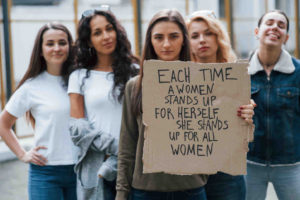
Studies have shown that diverse teams tend to be more innovative, productive, and successful. Yet, women and marginalized groups are persistently underrepresented in leadership roles.This leads to a lack of perspective at the highest levels of organisations.In many workplaces, women are subtly pushed into HR, marketing, or communications.These roles are often seen as “soft” or supportive. These roles, though crucial, are often undervalued and paid less, reinforcing the idea that women are better suited to be caretakers than decision-makers. Meanwhile, men continue to dominate technical and leadership positions. This quiet segregation keeps power concentrated and women conveniently out of the rooms where real decisions are made.
Women are often also excluded from important positions and tasks because employers see maternity and menstruation leaveas liabilities, preferring to hire males instead.
Women are muted, yet again, in a tailored suit, celebrated, wealthy, and successful corporate culture.
The Common Fate
From Kabul’s silence to corporate politeness—for decades the fate of women has been to be controlled, blamed, and be the sole bearers of the consequences. The condition of women in Kabul and women working in corporate might seem on the opposite ends of the spectrum, but they are just manifestatins of different forms of patriarchy.
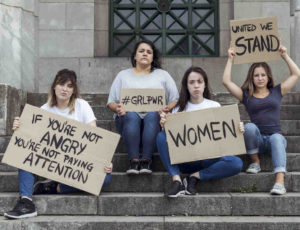
Whether it is the Taliban banning girls from education, public places, and speaking, or the corporate giants sidelining and excluding women in the name of “future family responsibilities”, the mechanism is the same—systems built to shrink women.
Yet, women persist. In Kabul, they run underground schools and broadcast on hidden radio stations. In corporate places, they speak up in meetings, demand reforms, and build companies that support other women and marginalized groups. Every day, they redesign systems that were designed to forget them.
Conclusion
I have never been asked to cover my body from head to toe, but I have been asked to dress “appropriately”; never not to laugh, but to “laugh like a lady”; never to stay silent during meetings, but to let the male counterparts lead the discussion. While I may not know the pain of all my sisters around the globe, I understand our common pain of being told to fit into a confining mold.
Patriarchy changes its accent from place to place, but the essence remains the same— don’t be too loud, don’t be seen, don’t be “too much”. Well, what is too much? This is not just about Kabul or offices in Manhattan; this is about all of us. I hear you, and I hope you hear me too.
