
CATEGORIES
Careers | Leadership and Networking | People We AdmireOverview:
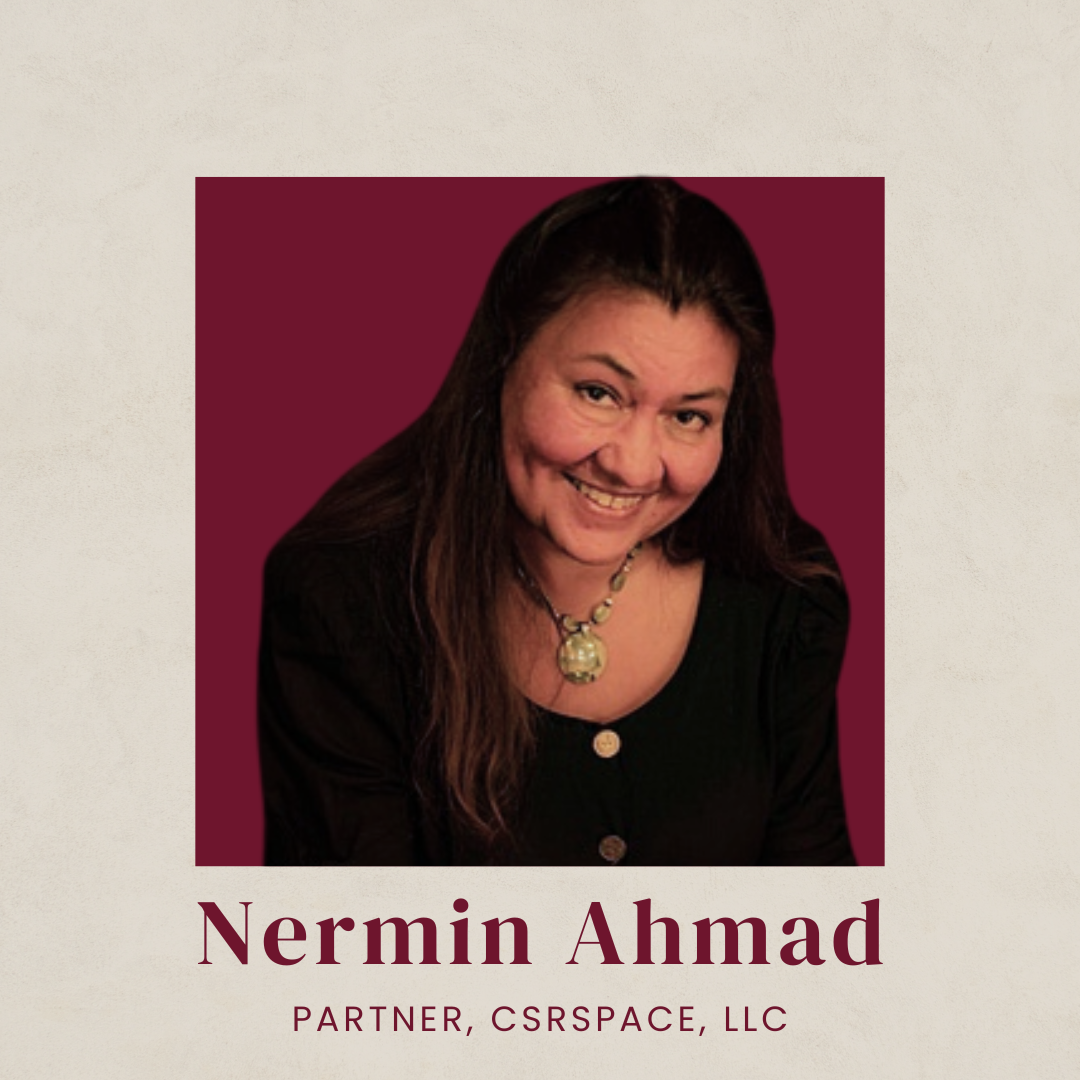
- Nermin Ahmad’s childhood was shaped by constant travel and frequent political unrest.
- Nermin later built an extraordinary career in consulting and resilience building.
- She continues to advocate for women and migrants, addressing xenophobia, racism and social inclusion.
1. Can you share your childhood anecdotes and family influences that shaped you into the woman you are today?
As a child of many heritages with a diplomat father, we always traveled a great deal. As children, our constant was to visit my maternal grandmother in Munich for a few months each year. My father (originally from Kolkata, later a Pakistani diplomat who then became Bangladeshi) committed to these trips to create a sense of belonging for us. We only missed the summer while we were under house arrest in Pakistan (1972.) Often, we would be dropped into a local school, mid-year, with a new language to contend with. Perhaps my mother, a trained kindergarten teacher, worried about this—but she never let us feel that there could be an issue: it was just a normal adventure.
Adventure is a theme that has always run through my life—there was no reason to fear change, as all change was an adventure. When we were under house arrest in Islamabad, it was a series of adventures to decide what we would sell, what we could keep and send out through friends, how we would escape, what we could eat (the International Red Cross gave us $89/month to live on, and my father used my 15th birthday party to access my dowry—a sum set aside monthly by the government from his wages.) It was an adventure to remember not to share anything about our home life with our friends.
We actually escaped as a family of four on muleback with opium smugglers across the Khyber Pass in January 1973. The trip took 5 days, starting with a cab ride from Islamabad to Peshawar, a visit to the Persian Miniature exhibition at the museum, a visit to Kim’s Cannon and tea at the Peshawar Club, where Rudyard Kipling wrote many of his books and dispatches. My father took the time to ensure that everyone we owed money to (the milkman, the club, the household staff) was fully paid up, with a bonus. This impressed me—leave no debts. Always engage in cultural opportunities. Learn.
My brother and I went with my mother to Germany, where our reception was different—my grandmother’s landlady made it clear that diplomats might be welcome, but refugees were not. We were able to get scholarships to go to Munich International School and entered a bucolic bourgeois interlude. Another learning experience, very different from being among diplo-brats! Because I skipped fourth grade, I was always the youngest in my class but felt so much older with all the adventures I had—experiences I learned not to share, as they made me too exotic, too different. We had very little money, but we had a wonderful time in a small apartment near Starnberger See, south of Munich. Finally, my father was able to join us, as he had found a job with the OECD in Paris, and our final year of school was at the American School of Paris.
My parents received help when we were in Pakistan from so many foreign diplomats who genuinely cared for them. My mother was welcoming to all, and when she was killed later on during an attempted coup in Kenya in 1982, people from all over the world sent letters of support, including an unforgettable telex signed by all the Air France pilots and staff who had flown her on the Paris-Nairobi route. She had an impact on everyone she met. That was worth aiming for. But I admit I spent a long time lost in pain before I could find my way out and become who I am, reflecting lessons learned from her and my grandmother — who left a life of luxury in St. Petersburg, Russia to end up in Berlin, Germany, in time for World War II — an experience that informed her, and my mother, and enabled my mother to see the man my father was, not where he came from, what he did, or the social trappings about him.
It is also what opened me to the man I married. We faced the world together with the motto — if not us, then whom? With our many experiences we had a duty to protect, to serve and to be there for others. He was an international journalist, and together we asked the hard questions, pushing interviewees to the right answers.
What shaped me? An acceptance of all people, all religions, all sectors of life. Trusting in family, in self, and not actively competing with or appearing better than others. The ability to speak several languages and to understand cultural differences in body language. An instinct for survival and an innate need to help others. Respect for everyone, then specifically for those who earned continued respect. Knowing that when times are bad, and you lose everything palpable, no one can take away the person you are, and the knowledge you have.

2. How did you move to the US to work?
I wanted to see if I could live in one place for four or more years never having done so. I also was bitten by the Hot Air Ballooning bug, and wanted to be a female pilot — at the time there were only 600 in the world. I also knew it gave me a ready made community to join. So I went to see my brother at Cornell, where he was an undergraduate, and went to Buffalo NY for a job interview. The icicles were at right degree angles to the trees!! I interviewed for a job, and interviewed a hot air balloon pilot/trainer. When I got the job, I started working with him. About 4 years in I met the man I would marry — and stopped flying balloons, grew as a woman, and began to march upwards professionally with my husband’s advice and support carrying me each step of the way. He erased my doubts, reinforced my will, and fine tuned my approach.

3. You have been a polymath working across industries and fields. What is the one common thread in all the roles you have held?
I think we often forget that education shapes our knowledge and provides us with tools we can use in the working world. With those tools, we can develop expertise in many areas. I jokingly called myself a “brain for hire,” because early on I realized that having been to respectable universities, I could hold the attention of clients. Most of my clients needed upper management to hear their ideas, without risk to their jobs. As an outsider, I could collect the ideas in an organization (through a needs assessment, stakeholder engagement, and interviews) and present a composite plan to management. If they liked it, everyone won. If not, only I would be told off. I was the integrator and communicator who built a safe space for expression.
Growing up in Asia, Africa, Europe, and North America attuned me to engaging with people of different backgrounds. It helped me avoid preconceptions. It made me realize who would step in to speak for others (older for younger, men for women, and so on) without giving a voice to each part of a community. How to make space for each of the voices. I also learned how to make people laugh (at me) to break the ice. To build trust.
An instance where I used these qualities was when I was working on a World Bank-funded project to evaluate water quality in a North African country. The Minister of Water was hostile to the project. In our introduction meeting, I knew he planned to cancel it. Arriving early, I asked the waiter to place jugs of water with glasses as well as the usual bottles of water. The minister arrived and gave his speech about the high quality of water in his country. When he asked me to defend the need for the project, I just asked: if you all trust the water here, why have none of you taken the tap water in the jugs? The bottles of water you are drinking cost as much as petrol per liter, but you all seem to prefer them. Dead silence. No one dared move. He chose to laugh, and the project was permitted.
4. Is there a particular project close to your heart that you wish to be remembered for?
There are many. If I had to select one, it would be the conceptual design of the New York City Citywide Assets and Logistics Management System (CALMS) that I proposed to the NYC Office of Emergency Management in 2003/4. We were retained to develop a logistics plan post 9/11 but were too efficient and would have left 2/3 of the contract funds on the table.
As the new (and first female) manager of the NYC office of a multinational company, I could not afford to do that. I had heard colleagues talk about an information technology/geographic information system they had built for the US Air Force. By taking similar approaches, we were able to build a system for NYC that is still in use and has grown with the needs of the city. It reduced logistics response time dramatically and enabled city agencies, state and federal agencies, non-profits, and corporations to collaborate in their responses. We created something robust and enduring by relying on a knowledge network engaging people from different disciplines to make a reality of my vision.
The importance of knowledge networks cannot be underestimated. Knowledge silos make us very fragile. Rubbing grey matter can ignite an unstoppable fire of ideas.

5. How do you think things have changed for women in the workplace, and how far do we still have to go?
It seems as if sexual harassment and advances in the workplace are less endemic—which is good. I hated that aspect of working in a male-dominated company. Yet, having said this, I also never tolerated people assuming that, as a woman with a Muslim name, I would be meek and easy to press down. The last man who touched me without permission received a broken jaw, courtesy of my right fist.
I remember my NYC staff were paid ridiculously low wages, and I would lose mostly female team members to job offers that were 35-45% higher. I could not get upper management to listen to me, so I flew on my own dime to headquarters, dressed in a pantsuit (I never wear pants,) and waited till the VP of Operations (a company founder) went to the men’s room. I followed him in and stood next to him at the urinal. He was taken aback, asking why. I responded with “I gather this is where business is done, and I need to discuss some items with you.” He asked me to leave, promising a meeting, and I returned with a universal pay raise for everyone in my office other than myself (I get that someone had to be punished.)
In my experience, women often are the worst managers in the workplace, either because they drive other women to excel beyond their abilities or because they do not want other women to compete for their positions. We need to stop bringing race, gender, religion, size, etc., into the workplace and should focus on knowledge, abilities, and experience. I built an office based on knowledge networking and created a team that was sublimely varied—fearless of projects outside our core knowledge areas. They had the tools in their toolkits to assess, identify a way forward, and work with our clients to undertake the necessary projects. We succeeded, since we received a great deal of follow-on work, tackling post-9/11 issues that never had been previously addressed.
6. What do you think is holding women back from finding their full potential?
The need to be liked and the need to feel safe and follow rules. The need to be in the know, sharing information in ways that verge on gossip, and the use of gossip to maintain or enhance their position. When I work, I am neither a man nor a woman – I am a center of knowledge and tools. I seek out others with knowledge and tools that complement mine—and create a team. Usually, it is very evenly distributed among genders, ethnicities, beliefs, and more. When I am obliged to work with an all female or all male team I can feel a loss in ideas, in variety.

7. How do you deal with a room that is either male-dominated or looking to listen to a man and not you?
I worked with county and city police, fire, and homeland security departments on the US / Canadian border emergency management plan. The officers were all male, and I knew this was going to be a challenge. I asked two of my high performing female colleagues (an Italian American and a Sri Lankan American) to dress in black suits and high heels. I dressed in a black and red suit. I asked them to sit on either long side of the table, not together, while I sat at the bottom. They asked questions and engaged the client in a discussion about the project. The men answered because the women were young, attractive, and polite. However, they did not show respect for the project in their responses. After 20 minutes, very quietly, I said, “Gentlemen, thank you—I see that we have a lot of work ahead of us, because you do not listen to one another or communicate adequately to create an implementable plan.” From then on, we had no issues. The project was deemed very successful.
Men expect nice-looking women who will listen to them. But they also have an innate response to a voice of authority and knowledge. I do my homework beforehand, researching the project needs and the people at the table, distinguishing between elected and career individuals. Very quickly elected people will see that my project concepts may lead to their re-election, and career folk see a raise in their future for a successful project. They buy in. We are no longer women, we are colleagues.
It is not as easy as it sounds, but being prepared, having a strategy in mind, and seeking help from other women to disarm the men or to echo what you have to say at meetings is key. If you let someone else take and present your ideas, you are not doing anyone any favors, as the person doing so often lacks the knowledge that went into designing the idea. Speak up and stand by your concepts. It is important to remember that if you stand firm, you may lose your job, but think: do you want a job where your knowledge is used without recognition? Never slink away in fear. Never be rude or say something unforgivable. Be fair, be clear, and above all, be well prepared.
8. Having become an inspiring leader yourself, what’s something you’ve unlearned about leadership over time?
Leadership is not about you. It is about your team. The strongest leader is embedded in their team, as a player but also as a referee. Let others take point with their ideas but invest time into shaping and honing those ideas, as a team. Do not throw teammates to the wolves but go with them to their meetings and presentations. Only step in when they flounder, and do not berate them in front of others. Quietly, in a neutral space, go over what could have been done better. Make sure your client sees that your colleague is part of a knowledge network, with a responsible person providing quality assurance and control, without stifling ideas.
My fellow managers accused me of only hiring beautiful people. I was concerned about that, as it was not in my criteria for hires. My main criteria were people who had lived on two continents, been to three continents, spoke two languages fluently, and had an extreme sport or artistic passion, or had grown up in NYC. My secondary criteria were a good education, work experience, and tool set. Then I realized that my staff were not scared of me—they liked and respected me and one another; they were confident in their knowledge; they were confident in their relations with their clients. Of course that made them appear beautiful. And made me a good leader.
9. What suggestions do you have for women looking to find a mentor to guide them in their journey?
My most amazing mentors were my mother and my grandmother. They taught me not to have fear but to own my decisions. Not to have regrets for mistakes, but to fix my mistakes and own them. When I recommend mentors in the working world, I always suggest a person who has been at the place of work for longer and knows the ropes, another in your own discipline, and a third in upper management (not your own boss, but above them.) This helps you understand and find opportunities while making fewer mistakes and protects you from being at the mercy of a bad boss. In your personal life, you need a mentor who sees you for yourself, whom you trust, and it should be someone you know you can outgrow. I honestly find that “friends” or groups such as real life or online social circles act more as echo chambers, not as mentors, and reduce you to less than you are capable of being, not through malice but through lack of knowledge.
10. It’s clear you find a lot of joy, purpose, and fulfillment in your work. We are curious as to what you do in your ‘me time.’
While I worked for others, my “me” time was devoted to my older husband, who increasingly had a hard time moving around. Today, my “me” time is spent giving back and donating time to various organizations and mentees. My downtime is when I am in transit—on a train, plane, or in a car—and I can just be, without responsibilities. I read, play computer games, create new recipes, work out, and explore, and recently began to try old sports again, such as windsurfing and horseback riding.
I do not spend time on social media as “me” time, because I do not want my ideas reflected back at me. Helping another human see clearly what confuses them is such a privilege; it is a very selfish “me” time. Life is so short that feeling the texture of each day, in each place, in every way, is already a reward for me. I have moved home 75 times, but looking at familiar books, at artwork, and being open to memories is important for me. As are my writings, my watercolor paintings, and my acrylic paintings—creating is a source of joy in itself. I am wide open to learning the way of others, and not keen on imposing my way on others. I like my scrambled eggs, but will never micro-manage another to do them my way (theirs could be better, who knows?).

11. What are your thoughts on “doing it all” or “having it all” for women?
I used to run a group called “Having it All” for women out of my office in NYC near Wall Street. Being able to talk in a safe space about balancing the tension among family, work, and spiritual/self-life was critical for attendees, and over the years, many have come back to me to say it clarified their individual approach to their futures and helped them succeed. Today, when I mentor people, I use a tool developed from that experience to help guide individuals to an attainable, more realistic future—often offering them so much more than they expected. We all need a “ah-hah” moment that allows us to see the more that we may be missing, the “more” linked to our own abilities and our own choices, and not to the expectations of the many around us.
I chose to be married, and chose to not have children. The 25 years I had with my husband made me grow exponentially – As did my employees – male and female. We talked out priorities through. He was not a Svengali, but he worked hard to unlock the full potential of those who collaborated with him. His employees managed to have very full and very varied lives. As did my female employees. We talked our priorities through.
12. In light of everything that’s happening in the world, how do you manage to remain hopeful?
What is happening today that is new? We just hear more rapidly about everything. My family has been aware of and warned about climate change since the Stockholm Conference in 1972—yet people treat it as a new issue that prior generations did not know about. The Russian/Ukrainian debacle was predicted in 2008 and had its roots earlier, but warnings were ignored. The question of Syria and of Iraq reached a head during the Treaty of Versailles in 1919 but had deep prior roots. Iran is also an unresolved issue dating back to the 1980s and earlier as well. Religions seem to come into conflict when resources are scarce. We are in a world with 8 billion people, in which few people are willing to engage in consequence management or planning. There are more people suffering from collateral damage. In sheer quantities, that is not acceptable.
We have a historic migration problem, but migrants have existed since caveman times—yet no one builds absorptive capacity plans to regularize migration. My grandmother escaped St. Petersburg, Russia, around the Russian Revolution; my grandmother and mother left Berlin after WWII, and she left Pakistan with us; I left Pakistan, and thankfully I have no daughter with whom I need to leave a place again (but at least I know what to do and how to do it, so I can help others.)
I do what I can through my networks of people to make life more meaningful. Our globe is beautiful, as are the majority of humans. We create a lot of confusion for ourselves—we should own our impact and reach out a hand to one another without becoming caught up in fear, anger, or weakness. Think about it: If you need to replace an organ, it can come from any other healthy human. Why would you differentiate among humans in other situations?

13. I came across the quote “Achieving change: If we don’t, who will?” on your LinkedIn handle. Change usually comes from a million small actions taken by thousands of people. How do you personally advocate for change in a way that feels actionable, or more accurately achievable, for an individual? How do you think the global integration of the world has affected the efforts in social impact?
Over time I learned I have a voice, and with that voice a responsibility to use it. I am president of the NYC Chapter of the National Federation of Business and Professional Women, founded in 1919. I am secretary on the Executive Committee of the NFBPWC, and I lead the Women on the Move Program within the NFBPWC. I am also the UN Representative for the International Federation of Business and Professional Women (in 115 countries.) At the UN, I was elected as treasurer for the Civil Society Committee on Migration and the head of the Subcommittee on Xenophobia, Racism, and Social Inclusion. I work on behalf of trafficked persons. I lead the Harvard Alumni Disaster Preparedness and Response Team to teach women and others how to take charge of their own successful response to devastation. If I do not speak to women about what they can do, how will they learn? Most people do not know what to ask, and unless they learn to ask the right questions, who will answer them?
I am intentional through my efforts in terms of integrating the efforts of other groups. I believe that efforts at making a social impact are scattered and not properly focused. For a talk at Harvard’s Business School, I looked at projects in the pipeline for a small part of Western Zambia. There were international projects from multilateral organizations, UN agencies, and bilateral international programs; there were national and regional projects; there were non-governmental organization projects, and there were individuals with projects financed through social sourcing—of the 2,157 projects I found, none were coordinated with one another across levels, and the implementation of some of them ended up being counterproductive. For instance, digging a well in one village led to water being poisoned in another, as no environmental impact assessment was conducted; the church financing the well was hoping to do good, but ended up doing harm. The only commonality: everyone sought personal reward for what they were doing at some level, and competed for scarce funds.
I truly believe if we stopped expecting others to do everything for us and used the available platforms to create opportunities for cross-globe collaboration, we would create a different social impact.
In 2010, I encouraged my team to create Project Earth. It allowed young people in schools to collaborate across the globe on environmental projects. It brought awareness of one another and understanding and created global teams with knowledge. It represented an unrecoverable cost for our company, and we had to close it. However, I am excited to see others have picked up the challenge with their own programs. We planted a seed, and the seed took off in different ways.
My company (Csrspace.net) believes doing things for others is not the best way to achieve meaningful social change. Everyone has to pay for advice and help. According to their means. I may charge one week worth of pay for focused consulting — I know the client will pay attention, even if (with the exchange rate) that one week of pay is just 10 US$.
14. What advice would you give to young girls struggling to find their voice within familial or traditional societal structures? How do you think cultural context is relevant to the empowerment of women?
I did not come from a traditional family or social structure. I think it was brilliant of my parents to never live in countries where one or the other side of the family predominated. Our family unit of four was always my home, my country, my safe space. When I thought I wanted to get married to someone I cared about, in a small island nation, my father congratulated me in his return letter, then asked whether I had thought of the answers to 17 questions he asked. They were excellent questions. We did not get married. Indirectly, but as a result, I have worked on meaningful projects across the globe, met with people who do me the honor of remembering me years later, and allowed me to have a personal impact on countless individuals, who felt shipwrecked on a globe beyond their understanding.
My advice would be to do your research, understand the immediate and broader consequences of the choices before you, and remember that there are 1000s of combinations of choices between action and inaction. To work independently, do you need to give up the family that raised you? Or if you do things in small steps, can you keep the family support while achieving your goals? What is your timeframe? What is in your toolkit, and what needs to be acquired before you push against traditional structures? Are you the first in your area, and if not, how did others do it? If you do not want to be “banished” from your traditions, how can you manage your progress to harness goodwill while succeeding? Often, we assume our families see things a certain way, forgetting that parents want to protect us but want the best for us. If you run away from home to take a job, you discredit them. If you achieve what is needed to be offered a job and let them know you have the offer you dreamed of, that there is enough support to keep you safe, and that they brought you up well enough that you would not get engaged with loose men, drugs, etc., because your focus is on your work and being recognized—you may find them supportive.
We all have cultural context, even if mine is multicultural. This is what ensures we have values and can understand others. Do not deny your background and past but embrace it as a strength in your future. Be open to change. In 2019 I recorded some thoughts for a friend, who created a piece of music to enhance my musings, and will be releasing it this year in Volume 3 of STANO’s Story Collection “In Between Silence: Where we Really Exist.” While listening to “I Came Home With The Sun” (Music composed by STANO, Story by Nermin Ahmad © STANO 2025) for the first time since I recorded it, I understood better who I am, and why I do what I do. This was truly a watershed moment for me. It may be for you as well.
Conclusion:
Nermin Ahmad’s life is a powerful example of turning adversity into an advantage. She escaped war-torn countries, built systems that continue to protect millions, and continues to advocate fiercely for equity and empowerment across borders. Her journey reminds us that we cannot wait for others to change the world. We must take that responsibility ourselves. Change begins with individuals who are brave enough to ask, “If not me, who?”
