

Overview:
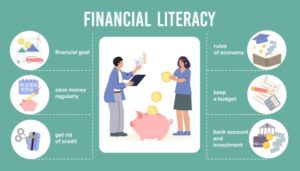
- Financial literacy helps in making appropriate decisions regarding budgeting, saving, investing, etc.
- Realizing the importance of finance has a positive impact on the future generation.
- Significance of financial literacy: The empowered mother, planner and protector.
Care, endurance, and self-sacrifice are some of the juices with which motherhood has been moistened across societies and generations. However, a new demand seems to have been placed on this role in the modern world: that of money management. Financial literacy is vital, especially for mothers who play a central role in household stability.
As economic systems develop in greater complexity, the need for making financial decisions often increases in frequency and consequence. Managing income, savings, debt, and future security is no longer a future-focused concern, but a daily one. In the absence of financial understanding, uncertainty often increases, quietly compromising long-term security.
Not through resistance, but through awareness, the rebirth of this woman is being marked. Financial literacy is reclaiming control, restoring confidence.

Economic Challenges Faced by Mothers
Economic circumstances have become more complex, and women have felt this change the most. Pregnancies, deliveries, and raising children can affect women’s working lives and, as a result, reduce their earnings. Women may have to work in part-time jobs that do not provide pensions. Also, increased living costs, childcare, and health concerns must all be managed simultaneously. However, there is limited availability of financial literacy programs and a general avoidance of financial topics. Planning is thus on the backburner, and financial decisions may be made on an emergency basis rather than strategically.

Financial Literacy as a Safeguard
Financial literacy is gradually becoming understood as an auxiliary mechanism for safeguarding economic uncertainty. Through financial education, informed decisions in areas such as budgeting, saving, investing, and insurance planning are gradually enabled. As economic concepts become understood, potential risks of economic loss are minimized.
Rather than being dependent on partners, family, or external advice, autonomy continues to be re-established. Confidence is no longer built on income alone, but on the ability to manage, preserve, and create wealth. Stability is being provided through knowledge, rather than fortune.
The Hidden Risks of Financial Dependence
Financial dependence can be an unintentional result. However, the implications can be severe. Without access to financial information, decision-making power is often relinquished unknowingly. Divorce or spousal death may expose a lack of financial self-sufficiency for mothers.
Such a dependency is seldom talked about openly, yet its effects are felt strongly. The choices dwindle, recovery slows down, and emotional stress increases. Financial literacy helps mitigate these risks before crises strike, replacing uncertainty with preparation.
Generational Benefits of Financial Awareness
The effects of being financially literate can trickle down to future generations. Children who grow up with financially literate women are exposed to money conversations. Saving, budgeting, and wise spending are concepts developed in the minds of young children through observation.
Children are essentially being raised in an environment where financial discussions are present. Over time, these positive financial behaviors are passed on. For example, confidence and responsibility with money are encouraged. In doing so, it ensures that future generations are better prepared to face even harsher economic times.

Redefining the Meaning of Strength in Motherhood
Traditional definitions of strength for mothers have included the notion of endurance, sacrifice, and self-denial. Today, it’s being reframed around preparedness, foresight, and informed decision-making. Financial literacy is now being viewed as an act of responsibility for oneself and one’s family. Stability is now being actively planned and organized instead of merely wished for. No longer are mothers simply seen as caregivers. They are now seen as planners, protectors, and creators of a safe future. Such a transformation represents a silent rebirth of womanhood.
Conclusion
The rebirth of the woman is not being announced loudly; it is being molded with a certain consciousness through knowledge. As financial literacy is adopted by mothers, dependence is reduced, confidence is built, and security is established. Financial education has progressed from status and power to protection, sustainability, and peace of mind. Foundations are being laid through informed decisions, not only for individual households but for generations to come. Financial literacy for mothers is no longer optional; it is being realized as a necessity.
