
CATEGORIES
#Business #Careers #EntrepreneurshipOverview:
- Schumpeterian creative destruction is actively reshaping Indian markets today.
- Digital infrastructure drastically reduces transaction costs for new ventures.
- Inclusive leadership is correcting historical labor market imbalances efficiently.
- Regional decentralization drives growth beyond metropolitan areas significantly.
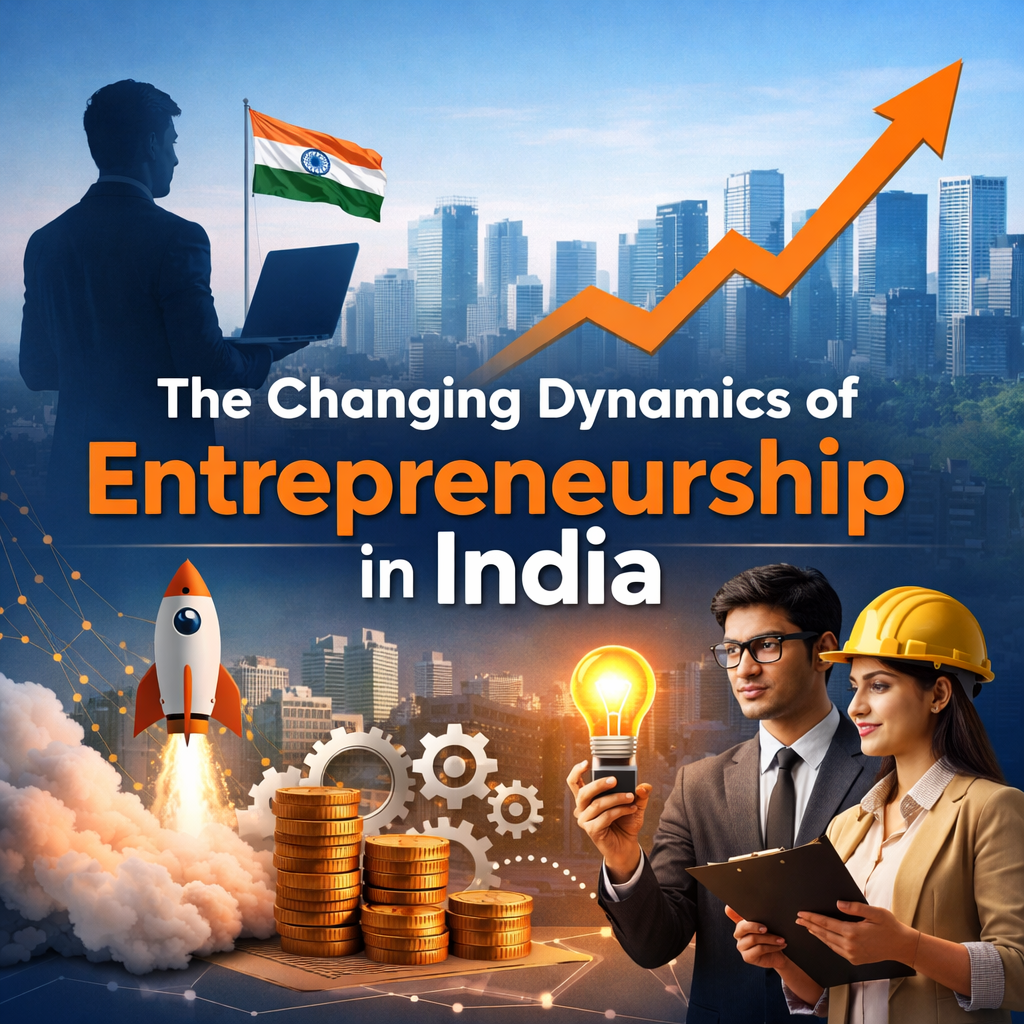
The Indian economy is currently a real-world case study of the Schumpeterian dynamics. We are witnessing “creative destruction” at an unprecedented scale. The old, inefficient market structures, that are omnipresent in the economy, are slowly dismantling. They are being replaced by the emergence of agile and technology-driven firms. And this does not account as a meagre trend rather a structural evolution of the economy. This structural evolution is hence, providing the roots to the changing dynamics of Indian Entrepreneurship.
The entrepreneurship landscape is shifting from a scarcity mindset to an abundance of opportunity. Unlike early 2000s, the market entry is not restricted by high capital requirements. Technology has effectively lowered the barriers to entry over the last decade. This democratization allows for a more lively, vibrant and competitive market. It challenges the dominance of the ‘legacy’ firms that once had control over the supply chains. Consequently, the consumer is the ultimate beneficiary, with the increase in competition, the customer’s positions continue to improve.
In more than one way, these structural shifts are more significant than the valuation or the funding metrics of today’s startups. That is because these economic foundations determine whether the Indian market is undergoing a temporary trend or permanent, robust evolution.
Macro-Economic Foundations
The traditional conglomerates no longer hold an undisputed monopoly over innovation. Startups are slowly but rapidly challenging the norms by leveraging technology to lower marginal costs. This increases the consumer surplus efficiency, as consumers gain more bargaining power. The market is now moving towards a perfect competition model. And effectively, the asymmetry of information and rigid market failures are diminishing.
Creative Destruction in Action
Entrepreneurs are the harbingers of this change. They introduce new production functions to the economy. This process further drives the total factor productivity growth effectively. As a result, the aggregate supply curve shifts outwards. This phenomenon, hence, is indicating a potential long-term increase in potential GDP.
Innovation is no longer restricted to just product development. It has now become inclusive of business model innovation and supply chain optimization. Startups are now removing the middlemen, and focusing on connecting the producers to the consumers. This reduction in the middlemen enhances the overall economic efficiency.
Rationalization of Capital
The economic cycle has also encouraged entrepreneurial behaviour. The recent global “funding winter”, was essential to correct the faults in the existing market structure. It shifted the focus from Gross Merchandise Value (GMV) to Earnings Before Interest, Tax, Depreciation and Amortization (EBITDA). The shift from valuation as a success metric was necessary to promote innovation.
Investors now demand sustainable unit economics from the founders. This ensures the maintenance of fiscal discipline among the new and upcoming businesses. This also closely aligns with the rational expectations hypothesis, i.e., investors’ future decisions depend on the current available information. Capital is now allocated towards businesses with real cash flows. This reduces the risk of asset bubbles in startups. Thus, the era of “burning cash” to attract customers is slowly declining.
The Digital Public Infrastructure
A major catalyst for this shift is the ever progressing Digital Public Infrastructure (DPI) in India. The introduction of Aadhaar, Unified Payments Interface (UPI), and Data Empowerment and Protection Architecture, have encouraged the upcoming startup culture. These developments have drastically lowered both transaction and time costs for the firms. Hence, Coase’s theory, the lowering of transaction costs reduces the need for large, vertically integrated firms, becomes relevant.
Introduction of UPI has enabled small firms to achieve scale without massive capital expenditure. This is due to UPI making financial access more accessible enabling micro-entrepreneurs to engage in the formal economy. Such inclusion is crucial for broad-base economic growth and particularly significant for large economies like India. And this inclusion also helps in curbing the size of the shadow economy significantly.

Image Credit- Freepik
Digital identity verification, Know Your Customer (KYC), has further streamlined the onboarding process for new customers. The processes that once took days, now can be completed in a few seconds. This speed has also increased the velocity of money in the economy. And has allowed startups to capture market share at an unmatched pace.
The Open Network for Digital Commerce (ONDC) is an equalizer that prevents monopolistic tendencies in the e-commerce sector. This enables small retailers to compete with giant aggregators efficiently and levels the playing field for new entrants significantly.
The digital revolution is essentially a supply-side shock. It has increased the capacity of the economy to produce goods and services. In more than one way, connecting small sellers to the mainstream market is valuable beyond just economic efficiency. This is because it unleashes the untapped potential of millions who have historically never been part of the formal economy. This integration would ensure India’s growth is sustained and becomes a lived reality that uplifts every street corner and village.
Spatial Economics and Decentralization
The Indian Subcontinent is characterized with spatial economic activity across the region. The startup revolution is moving beyond the metropolitan cities Bengaluru, Delhi and Mumbai. Remote work culture has enabled the workforce to be located across the country rather than being concentrated in metropolitans. Tier-2 and Tier-3 cities are emerging as new economic clusters.

Image Credit- Freepik
Cities like Jaipur, Indore, and Kochi, offering cost competitiveness are slowly emerging as startup hubs. Land and labour costs in these cities are much lower than the metros making them attractive places for startups. Talent from such cities is no longer migrating to metros solely and are finding opportunities closer to home. This retention of human capital enhances the local economies and creates a multiplier effect on local consumption and investment.
This spatial shift promotes inclusive growth and reduces regional inequality. Regional disparities have long infested India’s development journey and finally, entrepreneurship is bringing about this change. The local entrepreneurs solve local problems with context-specific solutions, creating a more robust and uniform economic network. It reduces the economy’s vulnerability to local shocks, making the entire system more resilient. We are now on our journey to a more polycentric economic model.
Inclusive Growth Engines
A critical dimension of entrepreneurial evolution is the rise of diverse founders. Historically, the Indian economy has battled low Female Labour Force Participation Rates (FLPR). But with the entrepreneurial evolution, we can bypass the traditional barriers to entry in the corporate market, especially for women.

Image Credit- Freepik
Women are creating ventures that address specific and often overlooked consumer needs. This has diversified the goods and services market substantially. Gender equality in leadership leads to positive externalities and improves a firm’s performance and innovation. A World Bank study shows that women reinvest around 90% of their earnings back into their families. This boosts human capital formation in the next generation.
Women entrepreneurship is not just a social goal, but a step towards smart economics. It expands the effective labour force supply and especially for India, it could potentially raise the GDP growth rate. Thus, gender inclusivity is a catalyst for macroeconomic stability.
Human Capital and Soft Skills
The startup ecosystem in India is also prioritizing human capital maintenance. The high-pressure environment often leads to burnout and hence, there is a growing focus on mental well-being within the sector. Sustainable output requires maintaining a healthy and motivated workforce. Hence, the founders realizing the appreciative nature of human capital is a step towards expanding workforce and employment in India.

Image Credit- Freepik
The demographic dividend requires distinct skill formation. Campaigns like Skill India, have focused intricately on enabling the youth, the potential future labourforce, upliftment using skill enhancement. The National Education Policy 2020, enabled the education system to catch up with the market needs. Vocational training and incubation centres are also bridging the gap between the skills and production efficiency. Human capital is the most critical input of production and the changing dynamics of entrepreneurship in India depend on it.
Structural Barriers
Despite the progress, there still exist market frictions in the economy. The “Ease of Doing Business” has improved, but challenges remain. Regulatory compliance is still high for early-stage firms and acts as a tax on innovation and growth. The compliance under Goods and Services Tax (GST) is tricky and complex especially for small and upcoming firms.
The Indian institutional framework still falls short when it comes to contractual enforcement. Coupled with judiciary delays, the costs of doing business increases. Efficient dispute resolution is essential for investor confidence. Another issue lies with the lack of substantial protection laws for Intellectual Property (IP) rights which hinders innovation.
The Credit market is far from perfect and hesitant to lend to the Micro, Small and Medium Enterprises (MSMEs). Banks are often risk-averse towards intangible assets like software, depriving tech startups of funding. For Indian policymakers, addressing these liquidity constraints should be a high priority and requires innovative financial solutions like blended finance. Hence, solving these supply-side problems would further unlock growth.
Conclusion
The changing dynamics of entrepreneurship in India reflect structural maturation. From women entrepreneurship to regional decentralization, the economic base is widening and accommodating more people. Technology is reducing barriers and correcting market failures. With prudent policy, this sector can drive India’s development. The convergence of democracy, demography, and digitization is powerful.
