
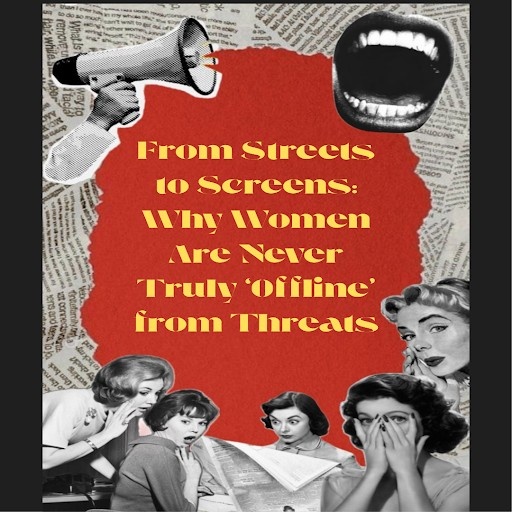
CATEGORIES
#Breaking Stereotypes #Feminism #Women EmpowermentOverview:
- Explores how women face constant threats both offline and online.
- Highlights harassment in public spaces and digital abuse on social media.
- Shows how safety becomes a daily calculation for women.
- Examines how online spaces reflect real-world gendered violence.
For many women, safety is not a place.
It’s a calculation. It begins on the street, with keys placed between fingers, phone clutched tightly, and location shared with a friend.
It continues in cabs, offices, and crowded markets. We are taught to be vigilant, not to make eye contact, and to walk quickly. We are told to dress appropriately, to make it home before it’s too late.
But here’s the truth we rarely say: even when women come home, close the door, and lock it, the vigilance doesn’t end. Because now, there’s the phone.
The Illusion of Logging Off
There was a time when home was a place of safety.
When closing a door, it meant closing out danger. Today, threats don’t even require physical presence.
They now come in the form of notifications. An unknown message. A random “hi.” A comment that turns from normal to violent. “A stranger asks for pictures.” A threat disguised as a joke. For women, connection is not the sole purpose of social media. It’s exposure. You don’t have to step outside to be watched anymore. You just need to exist online
Harassment Has Gone Digital – But It Isn’t New
Online abuse tends to be viewed as something separate from “real” danger. But for women, it feels like a continuation of it. In conversations around the male loneliness crisis, some narratives wrongly shift the blame onto feminism, yet this does not change the long-standing patterns of harassment women experience both offline and online.
On the street, it’s staring. Online, it’s unsolicited DMs. On the street, it’s being followed. Online, it’s being tracked, screenshotted, and shared without your consent.
On the street, it’s verbal abuse. Online, it’s rape threats casually written by people who will never face consequences.
The platform changes. The pattern doesn’t.
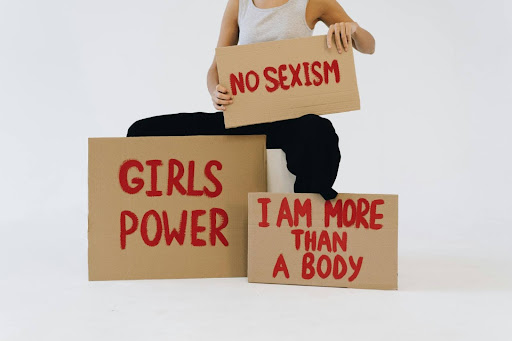
Image Credit: Pexels
Women Are Taught to Adapt – Not Be Protected
When harassment occurs in offline environments, women are told:
- Don’t go out late.
- Don’t wear that.
- Don’t respond.
When harassment occurs online, the advice sounds familiar:
- Don’t post pictures.
- Make your account private.
- Ignore the comments.
- Just block them.
The responsibility is always placed back on women. Rarely do we ask: Why are men so comfortable threatening women, both in public and anonymously?
The Emotional Price of Always Being Alert
Living like this changes you.
It teaches women to edit themselves. To think twice before posting a photo. To avoid sharing opinions. To limit visibility. To shrink. Many women have experienced the sudden shift, posting something harmless and being overrun with abuse.
A selfie becomes objectification. A political opinion becomes a threat. A professional success becomes character assassination.
The fear is not, of course, always dramatic. Sometimes it’s quiet—a sense of background anxiety that never totally goes away, leaving many women feeling like their voices are gradually becoming muted voices online.Not posting is self-preservation. And it has always been like this!
When the Screen Turns Into Surveillance
Technology has played a role in making it easier to control.
Partners monitoring phones. Ex-partners stalking with the help of fake accounts. Private pictures are shared without their consent.
Location tracking is misused. Digital spaces are supposed to be a way of connecting us.
But for many women, these spaces have become another source of vulnerability.
The scary part is not only the abuse. It’s the permanence. Screenshots don’t disappear. Posts can be shared and spread indefinitely.
One moment is weaponised, and we never forget it. Logging off doesn’t eliminate what’s already out there.

Image Credit : Pexels
The Myth of “Just Ignore It”
One of the most common responses women hear is: “It’s just online. Ignore it.”
But online threats are spilling into real life. Women have been doxxed.
Addresses leaked. Families harassed. Workplaces contacted.
The distinction between digital and physical is as thin as it’s ever been. algorithmic feedback loops on social media often amplify harmful content, allowing harassment to spread quickly and remain visible for longer. Even when the threats don’t materialise physically, the psychological impact is real. The body reacts to fear, whether it comes from a man in an alley or a message on a screen.
Public Spaces, Private Costs
The internet is meant to democratise voices.
It provides platforms for women to speak, build careers, and establish communities. But there is a price to being more visible.
Women journalists, creators, activists, and even ordinary users are disproportionately abused for the crime of existing in public.
The louder women’s voices get, the louder the backlash often becomes. And yet, silence seems a defeat.
So women learn to live in contradiction, wanting to be visible but bracing themselves for attack.
Why Women Are Never Really Offline
Because threats no longer have geographical boundaries.
You can leave a party early. You can change your route home. You can avoid a street. But you cannot completely avoid a digital world that is essential for work, communication, and social connections.
Women don’t get to step away entirely. Being offline is not always easy.
And even if it was, why would the solution be withdrawal?
Safety shouldn’t require disappearance.
What Needs to Change
The burden of safety cannot keep falling on women alone.
Platforms must react more quickly to threats. digital laws must evolve.
Online anonymity should not be an excuse for violence. Families must raise boys differently. Most importantly, we must stop normalising harassment as background noise.
Because it isn’t harmless. It isn’t inevitable. And it’s not something women should simply endure.
Conclusion
From the streets to the screens, women are taught to watch out.
- Careful how they walk.
- Careful how they dress.
- Careful what they post.
- Careful what they say.
But perhaps the real question is not why women are not more cautious. Maybe the real question is why only women are expected to be cautious? Both inside and outside their homes, they are supposed to carry caution wherever they go – even into their phones. Until that changes, women will never be completely offline from threats.
