
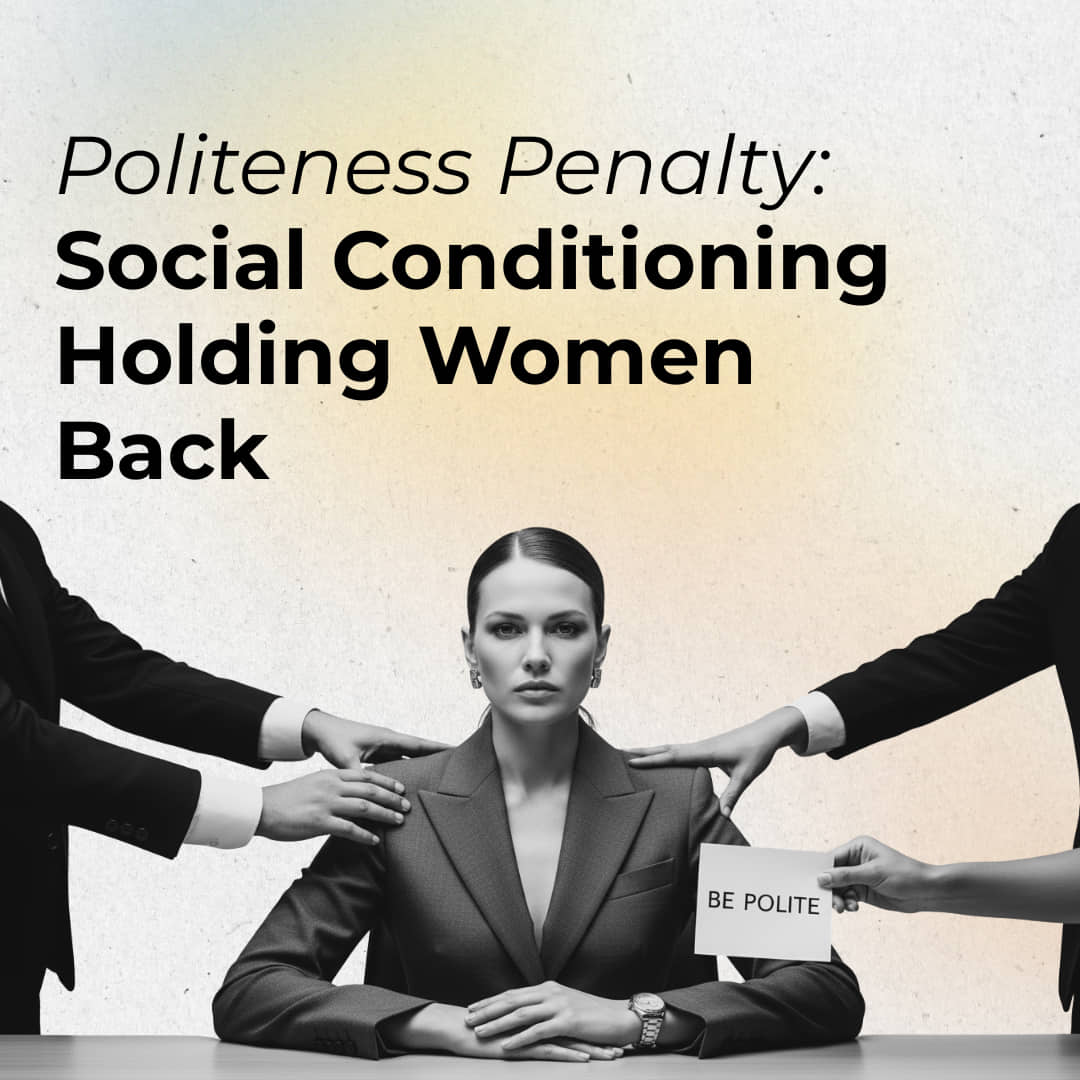
Overview:
- Women have been conditioned to be docile and pleasing.
- The work environment is actually rewarding those who are assertive rather than polite.
- This loophole usually leads to missed promotions and reduced salaries.
- Knowledge of the politeness penalty may enable women to negotiate in the workplace.
The politeness penalty emphasizes the presence of a not very obvious yet quite formidable workplace challenge that most women have to contend with. Some of the behaviors such as agreeable, accommodating and non confrontational are usually nurtured since a young age, yet this kind of behavior can narrow down visibility and development in the professional environment. Since the workplaces are prone to reward aggressiveness and self-promotion, this disparity introduces an imbalance in opportunities, recognition and compensation. These are the dynamics that can be understood in the first place to create more equitable working conditions and enable women to pursue their careers with confidence.
What is the Politeness Penalty?
Politeness penalty is a term that is used to refer to the invisible price that women pay when they are pleasant. Society puts pressure on girls to be nice, compliant and accommodative. Such qualities are useful in human relationships. The same qualities, however, may act as obstacles in the workplace.
Confidence and assertiveness are often rewarded at the workplace. Negotiative leaders are perceived to be competent. When women behave in the same way, the response may vary. Assertive women are termed as aggressive or difficult.
This hypocrisy creates a quandary. A lot of women are pressured to be courteous so as not to be criticized. However, politeness can make one less noticeable during performance.
It has always been found that women negotiate less frequently compared to men. The responses may not be as favorable when they do negotiate. This can lead to a reduction in career development.
The politeness penalty is thus an indication of a bigger problem. It shows that expectations in the workplace tend to conflict with gender norms that a person develops as a child.

Image Credit: Freepik
Social Conditioning and Gender Expectations
From childhood, girls and boys are treated differently. Girls tend to listen to such words as, be nice, do not argue, or allow others to talk first. These are directions that influence behavior over years and thus shapes young girls into socially conditioned women.
Boys, however, are usually encouraged to be bold and talk in an assertive manner. They are taught that leadership is being visible and communicating directly.
These initial lessons affect professional behavior over time. Women might be afraid to show their accomplishments. They may make appeals with additional excuses or retractions, or just undersell their achievements.
This trend has nothing to do with competence. Most of the well skilled women do not want to be seen as demanding as they fear being judged negatively.
There is also the social conditioning that influences how behavior is perceived by colleagues. An invitation by a lady can be ignored. A strong demand by a man could be taken as leadership.
Due to this prejudice, women tend to tread a thin line. They should also be likable yet authoritative. This act of balancing involves emotional work which a lot of workplaces do not acknowledge.
The Promotions and Salaries of Politeness
Politeness is not harmful but the implications can be serious. This can be seen most clearly in the processes of salary negotiations. Several practitioners are reluctant to talk about pay in an open way. This hesitation is more prevalent in women. They can also fear the repercussions of demanding higher compensation because they think this will affect their relationships with managers.
With time, minor salary differences accumulate into vast differences. Less initial salary is acceptable but may influence bonuses, increases, and retirements.
Women do not always take pride in their contributions during reviews. They do not focus on individual achievement, but on attributing the team or downplaying their contribution.
This submissiveness can be viewed as absence of leadership desire by managers. As a result, there might be a promotion of more vocal members, who do not even deserve it.
It does not necessarily end up in intentional discrimination. Most often it is based on unconscious prejudice and working practices. Nevertheless, the result is the same, excellent workers are deprived of work.
 Image Credit: Freepik
Barriers of Negotiation in the Workplace
The art of negotiation is a key skill in contemporary workplaces. The employees bargain wages, project assignments, resources and leadership.
But lots of women are not at ease starting these conversations which become controversial when it comes to them. Socially, they are usually not allowed to look demanding.
Women negotiating also have a reputational risk. Research indicates that there are those instances when colleagues will respond negatively to women who strongly demand themselves.
Due to this danger, other professionals choose more gentle tones of communication.
Although such a method maintains harmony, it may undermine the results of negotiations. Open requests are usually answered more clearly.
The other franchise is mentorship and networks, advice on negotiations is often spread during informal discussions. These networks might be more beneficial to men because there are leadership structures.
Women can lack guidance, which makes them less informed or confident during negotiations.
Organizations hardly impart negotiation skills in a systematic manner. Rather, they require that employees learn in the course of the experience.
Workplace Culture Re-Evaluation
The politeness penalty is not by only an individual challenge, it is also representative of general cultural trends in organizations.
Workplaces purport to embrace collaboration and emotional intelligence. However, reward systems tend to be more focused on visibility and assertiveness.
Bias can also be supported through performance evaluations. Employees who talk a lot during meetings would seem more powerful. Unobtrusive participants might not be recognized as well even with good performance, just because of being silent and observant.
Stereotypes of leadership have their influence as well. Leadership is traditionally associated with masculine qualities in society, such qualities include dominance, decisiveness and authority.
What is most modern in leadership though is the need to have empathy, communicate and collaborate as a team. Characteristics that are commonly described as polite may make organizations stronger together.
As companies broaden their definition of leadership, they gain access to a variety of opinions. Employees will also feel comfortable in conveying various communication styles.
Inclusion in workplaces thus needs structural reforms.
Evaluation processes can also be enhanced by training managers to be aware of unconscious bias.
This kind of reform is useful to make sure that politeness does not become a professional drawback.

Image Credit: Pexels
Plans to Surmount the Politeness Penalty
Systemic change is critical; nonetheless, individuals can also employ strategies to be able to maneuver within the workplace. To begin with, the professionals will be able to exercise effective communication. The negotiations can be misunderstood very easily in case of direct language.
Second, recording and tracking accomplishments can be used in performance reviews. Impacts and contributions can be evidenced by written records.
Mentorship is also a strong power. The trained professionals will be able to provide counseling on negotiations and career advancements.
Through networking, women get to share ideas and encouragement. Such communities will be able to enhance trust in professional spaces.
The other idea that can be applied is to reframe negotiation as collaboration. Mutual benefit to the organization can be emphasized during the discussions instead of personal gain.
Whenever people bring it out clearly and in a professional way, it breaks stereotypes without losing ground. In the long run, these initiatives can change the expectations in the workplace.
Conclusion:
The politeness penalty emphasizes one of the most subtle but effective barriers at the workplace. Women are conditioned to be amiable, and bossy behavior is usually rewarded by organizations. This imbalance may influence promotions, wages and the result of negotiations. To solve the problem, there should be individual approaches and structural changes in the working places.
