
CATEGORIES
#Business #Entrepreneurship #TechnologyOverview:
- Mid-sized firms use lean structures to outpace slow corporate bureaucracy.
- Granular data helps smaller companies deliver hyper-personalized customer experiences.
- Predictive analytics and AI tools optimize operations and strategic decision-making.
- Unified data systems connect departments to ensure a seamless customer journey.
- A data-first culture replaces gut feelings with evidence-based decisions.
- Specialized data insights allow firms to win on value rather than price.
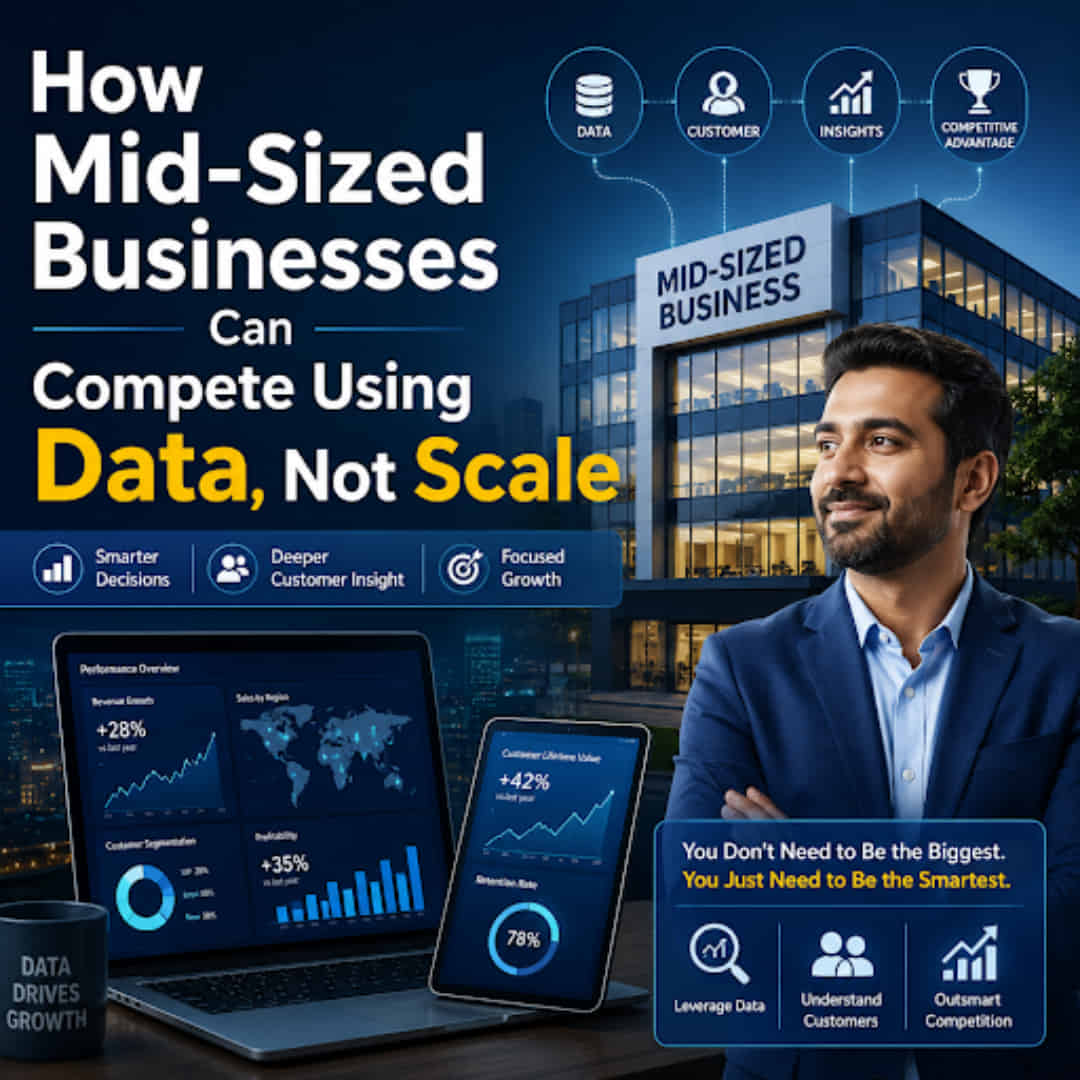
The contemporary corporate world seems to be akin to the battlegrounds of old where size alone was a decisive factor. The conventional wisdom for several years now has been that only large companies enjoyed the upper hand in business. This is due to their economies of scale, their deep pockets, and their worldwide reach. But the advent of advanced data analysis and the availability of artificial intelligence have changed the playing field. Mid-size companies today have learned that they don’t have to compete on the same level to succeed in the marketplace.
The Mid-Sized Advantage: Agility Over Bulk
One typical feature of big businesses is that they are faced with problems with legacy systems and excessive bureaucracy. This makes it hard for them to make decisions and implement those decisions rapidly. A small or medium-sized company will offer fewer products and a smaller management body, allowing it to react faster. Therefore, combining all the data in this kind of business will result in a powerful competitive advantage.
Big companies can take over six months to analyze the data and formulate a marketing strategy. Meanwhile, it will merely take weeks for a small or medium-sized company to establish trends based on the regional data. Instead of gathering as much data as possible, it is better to get useful conclusions from it.
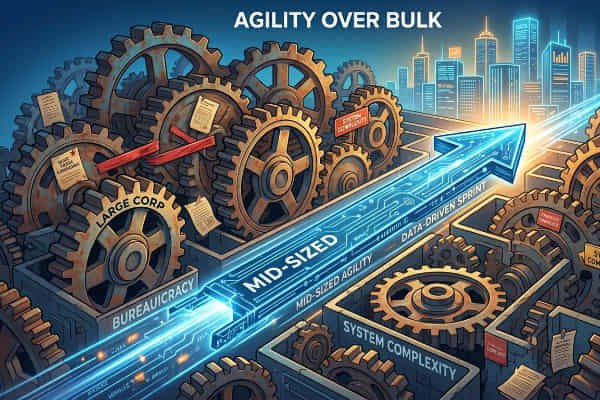
Image Credit: Gemini
Transforming Customer Insights into Personalization
One of the practical ways to utilize data is monitoring the journey of a customer. Major retail chains see their consumers as large groups of people belonging to particular demographics. While it is more likely for medium-sized firms to pay close attention to every single customer’s demands. Businesses will have the opportunity to personalize the experience by utilizing centralized CRM and data analytics tools.

Image Credit: Gemini
For instance, predictive analytics help mid-sized fashion houses determine exactly when a customer is ready to renew their wardrobe. Emails will be sent out suggesting the styles worn before and the correct size of clothing that fits the client.
Operational Efficiency: Doing More with Less
Resources being limited in such environments mean that wastes have high costs associated with them. In this setting, the use of data analytics becomes an important diagnostic technique that could help detect inefficiencies within the company. This is particularly the case in the context of managing the supply chain and inventory levels.

Image Credit: Gemini
The adoption of intelligent demand forecasting helps cut down wastage in terms of unnecessary holding of resources. This wastage is a result of overproduction. With AI, historical and current data help managers order just what is needed at a specific time. In fact, recent studies indicate that businesses using data-driven intelligence can see operational efficiency gains of up to 80%. Moreover, in manufacturing, sensors that collect data and help predict equipment breakdown allow for proactive maintenance, thus avoiding losses from equipment failure.
Smarter Decision-Making Through AI
No longer the prerogative of the tech aristocracy, AI technology makes it possible for mid-sized companies to automate the most mundane operations and get top executives the best summary of any data set. Therefore, today, the COO of a medium-sized manufacturing facility enjoys equal access to top-notch AI-powered predictive modeling to his or her counterparts in a Fortune 500 corporation. This shift is backed by recent data showing that 91% of smaller firms utilizing AI report significant revenue growth.
The applications of AI may include dynamic pricing that adjusts pricing according to current market trends and the price and availability of similar products offered by competitors. Moreover, AI could also assist in tackling HR issues by identifying the common factors contributing to high employee turnover and aiding the management in resolving the issue of organizational culture that can result in brain drain. Overall, it should be stated that AI is intended to aid human judgment rather than replace it. Many mid-sized businesses enjoy the advantage of being run by people with a good sense of the business. AI just confirms it or contradicts it, especially as conversations around AI, Fashion, and Sustainability continue to influence how industries approach smarter and more responsible growth.
Overcoming the Data Silo Challenge
Whereas the challenge may be thought of as lacking enough data, it is more accurately described as having all the data in separate departments. The sales department uses their spreadsheets, marketing uses their platforms, and the accounting uses their software packages. In order to be competitive, such companies have to tear down these barriers to develop an integrated outlook on the company.
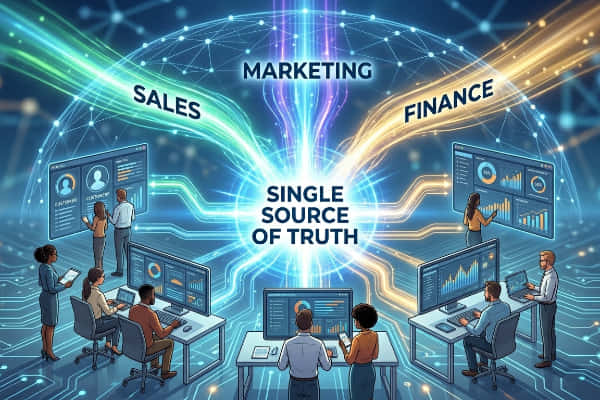
Image Credit: Gemini
By establishing a central location where data is collected, referred to as the single source of truth, the company creates the basis where everyone works using the same data. If the sales team sees the same customer data as the support team, then the service is provided consistently. The task of creating an integrated system may actually be easier when a business is small to medium sized due to the lesser number of departments involved. In this way, sustainable growth can be achieved without going through the troubles of scaling up.
Building a Data-First Culture
An entrepreneurial mindset is crucial to building a corporate culture in which respect toward data and its proper utilization become the cornerstone of the organization’s operations. Similar to how an entrepreneurial mindset empowers team members to innovate, a strong data-driven decision making culture encourages employees to rely on insights before taking action. This does not necessarily mean that all people within an organization should become data scientists. Rather, it means they start asking, “What do we know based on the data?” before making any decision.

Image Credit: Gemini
It is critical for the workforce to have basic training regarding how to read visualizations and comprehend the significance of high-quality data. When workers recognize that their contributions are essential in obtaining comprehensive insights for the company, they will maintain proper documentation.
Competing on Quality, Not Just Price
Large companies may always have an edge when it comes to offering prices at which they can easily win. This happens because they are in a better position to negotiate huge discounts due to their purchasing power. For a medium size company, getting involved in such a price war means entering a downward spiral. However, with the help of data, such businesses can compete by relying on value and relevance.
Data can show that there is a niche market that is under-served. For example, there is a high demand for eco-friendly packaging among some clients in one region or quick delivery services for a certain product in another market segment. Thus, by using data, the firm can become a niche specialist in addressing those needs, which means higher pricing capabilities for the same product.
Conclusion
In the current business climate, it is not about the gap between companies but rather intelligence and not labor. Organizations that decide to use data as their approach survive and go beyond. They become leaders by proving that speed and accuracy work better than size. The companies capitalize on their natural strengths such as individual attention and local know-how by using data. This ensures that what they do makes sense and will stand the test of time. Having scale might provide a competitive advantage, but only data will provide endurance.
