
CATEGORIES
Leadership & Impact | People We Admire | TechnologyOverview:
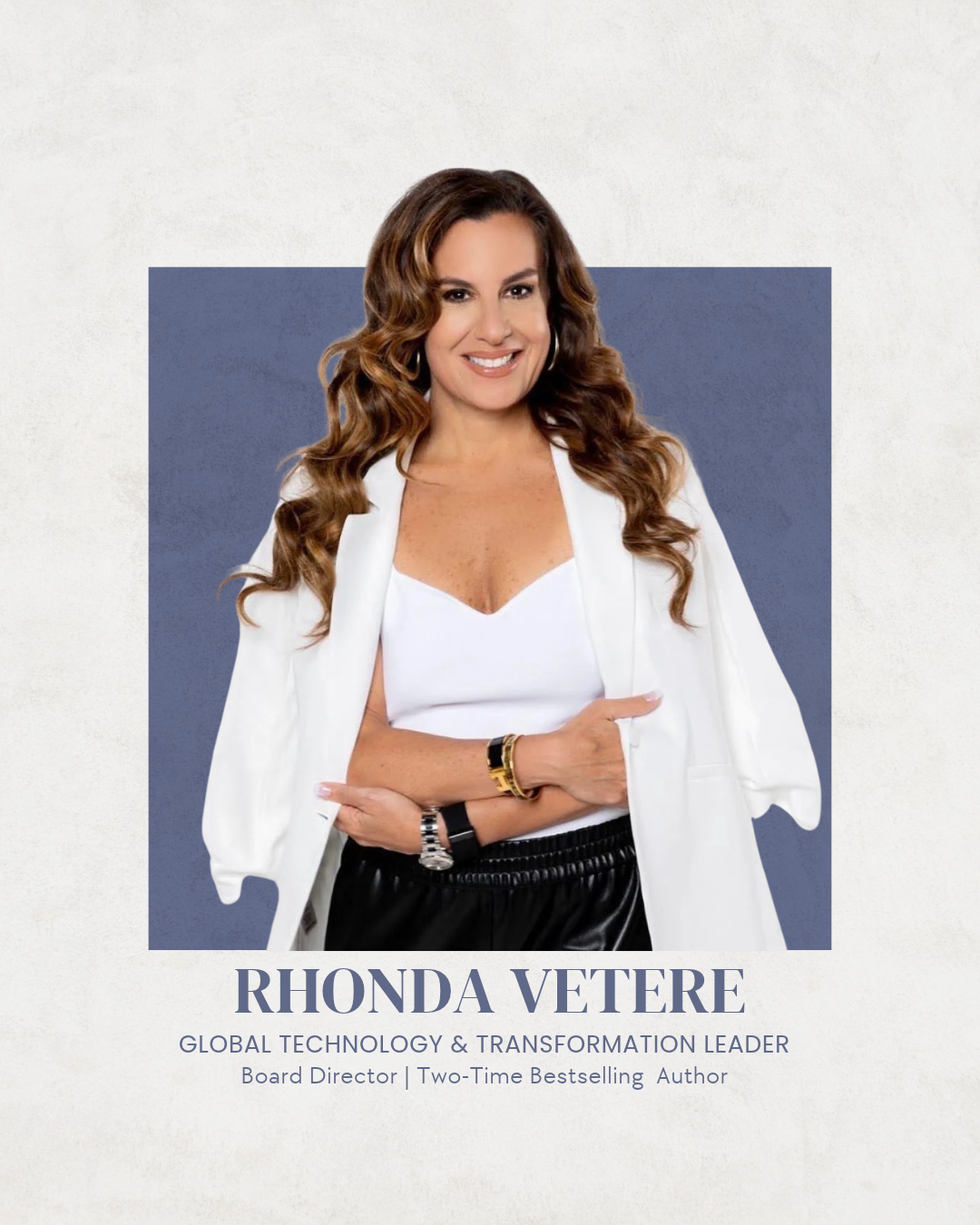
- Rhonda Vetere has led global transformations across banking, insurance, healthcare, aerospace, and other industries, managing teams of up to 20,000 people.
- She has been involved in 23 mergers and acquisitions, teaches at universities, and has taken part in conversations on AI, innovation, and leadership.
- She is a Global STEM Ambassador, a champion for women and girls in technology, a two-time bestselling author, and an endurance athlete.
- In this conversation, she shares what makes a culture high-performing, how to bring two company cultures together, how leaders should approach AI, and the lessons that have shaped her leadership.
Technology, Culture & Mergers
What first drew you to technology, and how did that early interest grow into leading global transformations?
Technology fascinated me because it can transform businesses, industries, and people’s lives.
Early in my career, I realized that technology was never simply about infrastructure, applications, or systems. It was about solving complex business problems, creating opportunities, and enabling organizations to perform better. As my career evolved, I became increasingly focused on the intersection of technology, business strategy, and people.
That curiosity led me into global executive leadership roles across banking, insurance, healthcare, aerospace, and other industries, where I’ve managed teams of up to 20,000 people and led complex business transformations.
I’ve always believed that successful transformation starts with understanding the business, developing a clear strategy, building the right culture, and executing with discipline. Technology enables transformation. People make it happen.

Across banking, insurance, aerospace, and healthcare, what makes a culture truly high-performing?
High-performing cultures are built on trust, accountability, transparency, collaboration, and measurable business results.
One of the most important distinctions I make is between a high-performing culture and a high-pressure culture. They are not the same. High-pressure cultures often create fear, burnout, and unnecessary competition, while high-performing cultures create ownership, innovation, teamwork, and sustainable results.
I’ve worked across industries with vastly different business models, regulatory requirements, and operating environments. Yet the fundamentals of great leadership remain consistent. People need clarity around the mission, confidence in their leadership, and an understanding of how their individual contributions drive organizational success.
I also believe leaders must understand the details of their businesses. You can not lead effectively from a title or spreadsheet alone. You must be visible, engaged, accountable, and willing to roll up your sleeves.
Great cultures don’t happen by accident. They are built intentionally, reinforced consistently, and measured through performance.
After navigating more than 20 mergers and acquisitions, what are the steps for integrating two company cultures?
Having been involved in 23 mergers and acquisitions, I’ve learned that integrating cultures is often more difficult than integrating technology, financial systems, or business operations. The first step is understanding the strengths, values, and operating practices of both organizations. You can not simply impose one company’s culture on another and expect success.
The second step is establishing a shared vision and clearly communicating why the organizations are coming together. Third, leadership alignment is essential. Employees need consistent direction, clear accountability, and confidence in the integration strategy.
Fourth, you must align people, processes, technology, and operating models, while identifying opportunities to retain the strongest talent and practices from both organizations.
Finally, integration must be measured through tangible business outcomes, including employee engagement, customer retention, operational performance, and financial results.
Communication throughout the process is critical. People need to understand what’s changing, why it’s changing, and how they fit into the future organization. You can merge balance sheets overnight. You can not merge cultures overnight.
Leading at Scale, Teaching & AI
What changes when you go from leading a few people to leading up to 20,000?
As organizations grow, leadership must evolve. When you’re managing a small team, you can be directly involved in most decisions and activities. When you’re responsible for thousands of people across multiple countries, you must create an operating structure that enables others to lead, make decisions, and execute effectively.
The most important priorities become leadership development, clear accountability, communication, organizational alignment, and measurable performance. You can not personally make every decision. You must build strong leaders who understand the mission and take ownership of results.
But regardless of the organization’s size, one thing should never change: treating people with respect and understanding the value of their contributions. I believe in setting high expectations while providing the tools, resources, and support necessary for people to succeed.
Leadership at scale isn’t about controlling everything. It’s about creating an environment where thousands of people can move in the same direction with confidence and purpose.
From your experience teaching at universities, what is the biggest misconception students have about technology leadership?
One of the biggest misconceptions is that being technically brilliant automatically makes someone a great technology leader.
Technical expertise is important, but successful leadership requires much more. You need business acumen, communication skills, emotional intelligence, financial understanding, and the ability to inspire and develop people. I encourage students to understand how businesses operate, how organizations generate revenue, and how technology contributes to strategic outcomes.
I also remind them that leadership is not defined by a title. Leadership begins with accountability, curiosity, integrity, and the willingness to take initiative. I encourage young professionals to find mentors, ask questions, embrace difficult assignments, and continuously develop their skills.
Technology will continue to evolve, particularly with artificial intelligence. The ability to learn, adapt, and lead through change will be just as important as technical knowledge.Your technical skills may get you into the room. Your leadership skills determine what you accomplish once you’re there.
Reflecting on conversations around AI, innovation, and leadership at Davos during the World Economic Forum, how should business leaders approach AI adoption?
Artificial intelligence represents one of the most significant transformations in modern business. However, AI adoption can not simply be treated as another technology implementation. It requires a fundamental examination of business strategy, operating models, workforce capabilities, data readiness, governance, and organizational culture.
I believe leaders should begin by identifying the business problems they want to solve. Are they improving customer experiences? Increasing productivity? Creating new revenue opportunities? Strengthening decision-making? Technology investments must be tied to measurable business outcomes.
Organizations also need to ensure their data is reliable, their cybersecurity and governance frameworks are strong, and their employees are prepared for changing responsibilities.
I believe deeply in workforce development, reskilling, and apprenticeship opportunities. AI will change existing jobs and create new ones, and leaders have a responsibility to help employees navigate that transition.
Successful AI adoption is not about replacing human potential. It’s about expanding it. The organizations that succeed will not necessarily be those spending the most money on AI. They will be those that combine technology, business strategy, and human capability most effectively.
STEM, Purpose & Being a Force for Good
What did being inducted as a Global STEM Ambassador in Meghalaya, India, mean to you?
Being recognized as a Global STEM Ambassador in Meghalaya, India, was an extraordinary honor. It was particularly meaningful because education and access to opportunity have always been deeply important to me.
A university and a Bio Diversity park in India are named after me, and the Prime Minister of India presented me with a golden scroll as Global STEM Ambassador.
I came from humble beginnings, and I understand how transformative education, mentorship, and encouragement can be. STEM education creates opportunities that cross geographical, economic, and cultural boundaries. It empowers young people to imagine futures they might not otherwise have considered possible.
For young women especially, representation and access matter tremendously. I want girls around the world to understand that they belong in technology, engineering, science, and executive leadership. Recognition is wonderful, but I believe it also comes with responsibility. The true value of an honor is what you do with it to help others.

Your commitment to advancing women in STEM and supporting girls’ programs in Tanzania reflects your dedication to creating opportunities. What would you tell a young girl who dreams of pursuing technology?
I would tell her that where she starts in life does not determine where she can finish. Never allow your circumstances, background, or someone else’s expectations to limit your ambitions.
Be curious. Work hard. Ask questions. Find mentors. Take risks. And never be afraid of difficult challenges.
Through my work supporting women and girls, including initiatives in Tanzania, I’ve seen the importance of education, encouragement, and access to opportunity. Talent exists everywhere, but opportunity does not. As leaders, we have a responsibility to help close that gap.
I would also tell young girls that they do not need permission to pursue their ambitions, and they do not need to become someone they’re not in order to succeed. Confidence comes from preparation, persistence, and the willingness to keep learning.
I want young women to understand that they can become engineers, scientists, entrepreneurs, CEOs, and global technology leaders. But most importantly, I want them to know that success is not reserved for people who come from privilege. With education, opportunity, mentorship, and determination, extraordinary things are possible. My message is simple: Dream big, work hard, stay humble, and never stop believing in your potential.
What does being a force for good mean to you, and which part of your career has had the greatest impact?
Being a force for good means using your experience, resources, relationships, and influence to create opportunities and improve the lives of others.
I’ve spent decades transforming global organizations, building high-performing teams, and delivering measurable business results. I’m proud of those accomplishments, but some of my most meaningful experiences have come from helping individuals overcome barriers and achieve goals that once seemed impossible.
One experience that stands out is guiding Chris Nikic through a full IRONMAN 140.6. Chris has demonstrated to the world that determination, preparation, teamwork, and belief can break through perceived limitations. Being part of that journey reinforced everything I believe about leadership. Great leaders see potential in people, help them develop confidence, and create environments where they can succeed.
Through my board involvement, philanthropic initiatives, mentorship, and global network, I strive to continue creating opportunities for others.
I’ve always believed that success is not simply measured by titles, financial accomplishments, or recognition. It’s measured by the positive difference you make.
Success is what you accomplish. Significance is what you make possible for others.
Grit, Endurance & Beyond the Boardroom
What inspired you to write Grit & Grind, and if you could add an 11th principle today, what would it be?
I’m a two-time bestselling author, and my two books reflect different but equally important aspects of my professional and personal journey. My first book focused on technology and business leadership. My second book, Grit & Grind, is about something much more personal: perseverance, resilience, discipline, and the determination required to build an extraordinary life.
I came from nothing. My journey was not built on privilege, shortcuts, or connections handed to me. It was built through hard work, sacrifice, persistence, and the willingness to keep moving forward through adversity. I’ve experienced professional challenges, personal setbacks, difficult decisions, and moments when giving up would have been the easier option. But I kept going.
I wrote Grit & Grind because I wanted people to understand what success really looks like behind the scenes. Social media often celebrates the finished product without showing the years of preparation, sacrifices, disappointments, and discipline required to get there. I’m not interested in portraying a perfect life or becoming a social media influencer. I’m interested in sharing real experiences that help people grow, develop resilience, and achieve meaningful goals.
If I could add an 11th principle today, it would be: Use your success to lift others. Personal achievement is important, but helping someone else succeed creates a legacy that extends far beyond your own accomplishments. Grit gets you through the difficult moments. Grind is what you do every day when nobody is watching.
As an accomplished endurance athlete, what does competition day teach you that the boardroom can not?
I’ve completed more than 157 endurance races since 2016, and endurance athletics have profoundly influenced my leadership philosophy. I’m different in the corporate world because I’m relevant and still competing.
Whether I’m competing in an IRONMAN, running a marathon, or preparing for another endurance challenge, the lessons are remarkably similar to those I’ve experienced leading global organizations. Preparation matters. Discipline matters. Execution matters. But perhaps most importantly, your ability to adapt when things don’t go according to plan determines how you respond to adversity.
You can train for months for an IRONMAN, but on race day, unexpected challenges inevitably arise. The weather changes. Your body responds differently. Your strategy may need to evolve. Business operates in much the same way. You can develop an outstanding strategy, but successful execution requires resilience, adaptability, teamwork, and mental toughness.
Endurance sports also teach humility. The racecourse doesn’t care about your job title, professional accomplishments, or reputation. You have to put in the work. And while endurance competition may appear to be an individual pursuit, there is always a team behind every successful athlete. That same principle applies to leadership. No executive achieves extraordinary results alone. The strongest leaders surround themselves with talented people, build trust, and recognize the contributions of their teams.
The racecourse and the boardroom ultimately reinforce the same lesson: preparation, discipline, resilience, and teamwork create sustainable success. There is no finish line when it comes to personal growth, leadership, and helping others.
How can our audience contact you? Share with us your socials 🙂
Rhonda Vetere LinkedIn: https://www.linkedin.com/in/rhondavetere
Rhonda Vetere Website: https://www.rhondavetere.com/
Rhonda Vetere Personal: https://www.instagram.com/rhondamvetere/?hl=en
Conclusion
Rhonda Vetere’s story shows that technology enables transformation, but people make it happen. From leading teams of up to 20,000 and navigating 23 mergers and acquisitions to guiding Chris Nikic through a full IRONMAN and supporting girls and women in STEM, she keeps coming back to the same belief: success is what you accomplish, and significance is what you make possible for others. Her message is to dream big, work hard, stay humble, and use your success to lift others.
