
CATEGORIES
#Business & Economy #Work Culture #Workplace CultureOverview:
- One-size-fits-all workplace models leave little room for differences in roles and needs.
- Many employees work in arrangements they would not choose.
- Career stage, caregiving, working style, and commute change what employees need.
- Flexibility has costs, so it needs guardrails and good management.
- A four-step framework helps managers decide what to standardize and what to flex.
Introduction
Employees differ in their career stage, workload, working style, and distance from work. A single rule for where and how everyone works helps some people but creates challenges for others. Organizations can address this by deciding what stays standard across the company and where flexibility can be built in.
What Is a “One-Size-Fits-All” Workplace Model?
A one-size-fits-all workplace model follows the same structure for everyone. The organization determines where and when the employees work and specifically how they are expected to collaborate. These expectations generally apply across the workforce, leaving little room to adapt to differences in roles, career stages, or individual circumstances.
The flexible workplace, by contrast, establishes a different approach. Instead of making every aspect of work uniform, it sets clear standards for what must remain consistent, such as goals, security, and compliance. Within those boundaries, employees and teams have more flexibility in location, schedule, and collaboration.
How Divided Is the Workforce on Where to Work?
The debate over where people should work is often presented as a choice between remote and office work. The data suggests that the reality is more complicated. Employees do not necessarily want the same arrangement, even when their jobs allow them to work remotely.
Among remote-capable U.S. employees, Gallup’s May 2026 data shows: 52% work hybrid, 26% work fully remote, and 22% work on-site. But their preferences do not always tell the same story: 61% wanted hybrid, 33% wanted fully remote, and only 6% wanted on-site work.
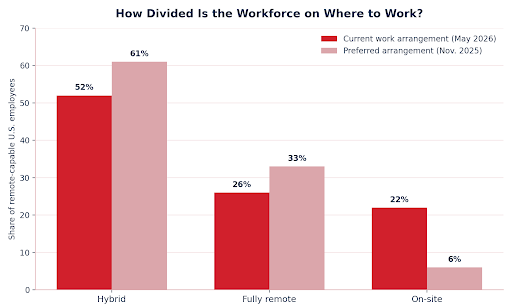
Hybrid work is already the most common arrangement, but it still falls short of the share of employees who would choose it, as many of them are in arrangements they would not choose. Another study of 482 employees across Australia and Europe shows the importance of fit. It found that one-third experienced a mismatch between their actual and preferred work arrangements, and those employees were considerably more likely to leave.
This means remote work is not automatically better for every employee or organization; it challenges the idea that a one-location policy works equally well for everyone. Employees normally look for workplaces that give them some choice, not ones that assume the same arrangement will work for everyone.
That is why the future of work may be less about choosing the right workplace model and slightly more about designing workplaces that can accommodate different preferences and circumstances.
Who Needs What? Four Employees, Four Answers
The Early-Career Employee
Take a 23-year-old analyst who has just gotten her first job. She will need to learn. That will mostly be done by watching experienced colleagues work and getting quick feedback. Only a small percentage of remote-capable Gen Z employees prefer fully remote work, which generally differs from older generations. This shows that mentorship matters most for early-career workers and can be harder to build remotely.
The evidence points the same way. One study of software engineers at a Fortune 500 firm found coding feedback rose 18.3% when workers sat near their teammates.
The Mid-Career Person
Picture a 38-year-old project manager. Predictable schedules and less commuting can decide whether she stays. In Stanford’s randomized trial of 1,612 employees, hybrid work cut quits by a third, with the strongest effect among women, non-managers, and long-distance commuters.
The Experienced, Independent Worker
Consider a 52-year-old senior researcher whose best work happens in long, uninterrupted blocks. She needs control over her time and place. Fully remote and hybrid employees are more likely to be engaged and thriving than on-site, remote-capable peers. Remember that she still needs deliberate opportunities to connect and collaborate with her colleagues.
The Employee with Long Commutes
Picture an employee who lives an hour from the office. Here the deciding factor isn’t generation or caregiving. It’s basically time lost in transit. Long commutes carry a health cost independent of turnover and are linked to increased stress; both stress and commute-driven absenteeism are associated with lower engagement and greater work-life conflict.

Beyond these four:
This is not an exhaustive list. Others include neurodivergence, chronic health conditions, immigration or visa status, time-zone differences on distributed teams, and cultural or religious scheduling needs. The range of relevant differences itself shows that this subject extends well beyond any single framework, and is worth revisiting.
What Is the Evidence on Productivity and Retention?
The strongest evidence supports that flexibility does not come at the cost of productivity and meaningfully improves retention.
Stanford’s randomized trial of 1,612 employees tested two remote days a week against a full-time office schedule. Managers had predicted a 2.6% productivity loss. Instead, performance reviews, promotions, and lines of code stayed level, and resignations fell by 33%. The gains were largest among non-managers, women, and long-distance commuters.
Commute research points the same way: each extra 5 minutes of one-way travel raised the odds of an employee leaving. A modest, structured hybrid schedule outperformed a rigid on-site requirement.
A modest, structured hybrid schedule outperformed a rigid on-site requirement. The evidence supports designing flexibility deliberately, and not removing structure altogether.
Is Flexibility Always Better?
No. It has costs on the other side.
- Weaker mentorship and feedback. Early-career employees learn by watching colleagues and getting quick feedback; remote arrangements can slow that learning if nothing replaces it.
- Empty-office risk. Gen Z may miss hybrid work’s in-person benefits if they arrive to an empty office.
- Poor management. Problems with fully remote work arise when it is not managed well.
Offering employees more freedom can help organizations accommodate different needs and working styles. At the same time, keep in mind that flexibility alone does not solve every workplace challenge.
Does Flexibility Mean Complete Freedom?
Four ideas get confused:
- Individualized work: tailoring arrangements to a person’s role and needs.
- Unlimited choice: everyone works however they like. This is not workable.
- Reasonable flexibility: variation inside guardrails.
- Business and team requirements: client coverage, security, key collaboration days.
The goal is 3, bounded by 4. Teams should set those bounds together because hybrid models work best when teams, not individuals, decide the rules. Yet only 11% of employees work on teams that set their hybrid policy together.
What Role Does the Manager Play in Making Flexibility Work?
Flexibility works only when managers know how to run it.
The Happy Manager describes good management as three dimensions working together: Head (knowing the evidence), Hand (applying it in practice), and Heart (understanding people as individuals).
The same three dimensions apply here.
Head: knowing what must stay standard and what the research says about flexibility.
Hand: setting anchor days, mentorship pairings, and review cycles.
Heart: recognizing that an early-career analyst and a long-distance commuter need different things.

How Can Organizations Apply This? A Four-Step Framework
- Identify what must be standardized: Goals, performance expectations, security, and compliance.
- Identify what can flex: Location, schedules, communication methods, and collaboration practices.
- Account for employee differences: Career stage, role, workload, accessibility, and team needs. Give early-career staff structured in-person time with mentors.
- Review whether it works: Track retention, engagement, performance, and direct feedback, not assumptions. Always adjust by team.
Assume a firm requires two anchor days for client work, pairs new hires with mentors, and handles accessibility through an individual interactive process. It then checks turnover and engagement each quarter.
Conclusion
No single work model fits every employee. Career stage, commute, and working style all shape what someone needs to do their best work. Standardize what protects the business, let the rest flex by team, and check the results against retention, engagement, and performance data.
