

Overview:
- Popular culture often teaches women that success requires leaving home.
- ADÉLA’s “Ain’t in LA” challenged the idea that ambition belongs elsewhere.
- Women can work remotely and access global opportunities without relocating.
- Fair cross-border work should value women beyond geography and labor costs.
- Women’s talent already exists beyond traditional centers of opportunity.
Why Women Are Taught to Leave Home for Success
Many of us grew up consuming stories where a woman seems to become someone only after leaving home. We know the scene: suitcase in hand, hometown behind her, bigger city ahead. In Sweet Home Alabama, for instance, Melanie leaves Alabama and builds a life as a New York fashion designer. The film eventually complicates that fantasy, but the image itself is familiar.
The more these stories repeat themselves, the easier it is to mistake them for a natural order of things. A woman leaves, moves somewhere bigger, and suddenly her life appears to begin. After seeing that story often enough, distance from home can start to feel like a proof of progress. Leaving begins to look less like a choice.
Women leave home for very different reasons. Some seek independence or careers unavailable nearby. Others face low wages or limited employment that leaves little room to choose. In some rural communities, families may borrow money or part with their livelihood to finance migration. UN Women has documented how poorly regulated sectors can leave women migrant workers exposed to trafficking and exploitation.
Choosing to leave is one thing. Leaving because staying offers too little is another. When better jobs sit elsewhere, women are expected to reshape their lives around opportunity. Some can now work remotely, though access to that option remains uneven.
So why should opportunity depend so heavily on relocation? Perhaps workplaces can also ask what they can bring closer to women where they already are.

The “Baddest B*tches Ain’t in LA” TikTok Trend, Explained
There is always a new trend circulating on social media. Most disappear quickly. Others stay because people see something of themselves in them.
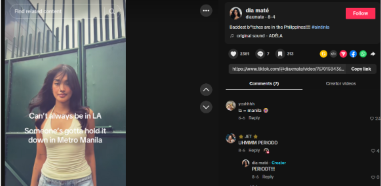
ADÉLA’s “Ain’t in LA” became one of those trends. Users began making the song’s premise their own. The joke was that the “baddest b*tches” could not all be in Los Angeles. Someone’s gotta hold it down in Mexico, Manila, Surabaya, Punjab, Bratislava, and countless other places.
Women in particular seem to have found room in that joke. Hometown pride becomes something more personal. They say that ambition and confidence can exist outside places that popular culture treats as centers of possibility.
ADÉLA’s cultural context gives the song another layer. She grew up in Slovakia with Western pop culture around her, then moved to Los Angeles for music. She has spoken about how distant global success once felt from a small Eastern European country.
The song also reaches back to her family. ADÉLA has described seeing photographs of her mother as a teenager in Slovakia, surrounded by Western pop imagery. Those pictures made her think about women with large dreams who may never receive the same access to recognition. Perhaps that is why the trend travels so easily. It takes a lyric about Los Angeles, a city deeply tied to the American Dream, and lets women answer from somewhere else. Home enters the story as a place where ambition already exists, rather than somewhere success requires them to escape.
Who are the “Baddest B*tches”?
The word “bitch” has carried questions of power for centuries. More than a thousand years ago, Old English recorded bicce as a term for a female dog. It later became a gendered insult for women considered outspoken, sexually confident, or difficult to control.
That history says something about acceptable female behavior. Traits such as authority and ambition could attract condemnation when women expressed them. The insult therefore did more than describe a person. It helped police the boundaries of how women were expected to behave.
Language, however, can be reclaimed. Feminist movements, popular culture, and LGBTQ+ communities have repurposed “bitch” in contexts of confidence and self-possession. In ADÉLA’s song, “baddest bitches” carries this sense of confidence and power. It points toward women who claim space and recognition on their own terms.

When Opportunity Crosses Borders Instead
If opportunity has historically been concentrated in certain places, remote work offers another arrangement. Women can work remotely with international teams without relocating to major business centers. This can still give women access to international work while letting them stay rooted in their own communities.
Still, the ability to work remotely does not automatically create an equitable workplace. Cross-border hiring can widen access while also reproducing unequal labor relations.
Making global opportunities more meaningful can include:
- offering fair compensation rather than using geography to undervalue labor;
- creating clear paths for professional growth and leadership;
- giving women who work remotely meaningful responsibility and visibility;
- supporting collaboration across time zones and cultures;
- evaluating global workers as professionals, not simply as lower-cost labor.
Girl Power Talk is one example of a workplace built across borders. Young professionals from different countries can work remotely within the same organization. Yet the larger point extends beyond one company.
Workplaces should ask how global opportunities can reach women wherever they are. Women who work remotely should not trade fair treatment for geographic access. Migration should not become the price of ambition, and location should not determine professional worth.

Conclusion
“Ain’t in LA” resonates because it rejects the idea that ambition belongs somewhere else. Women have always built skills, careers, and aspirations far beyond the cities usually associated with success.
The ability to work remotely across borders can widen access when workplaces also value the people doing that work.
The talent is everywhere. What matters is whether workplaces are willing to see it and make room for it.
The baddest b*tches do not need to arrive.
They are already here.
