
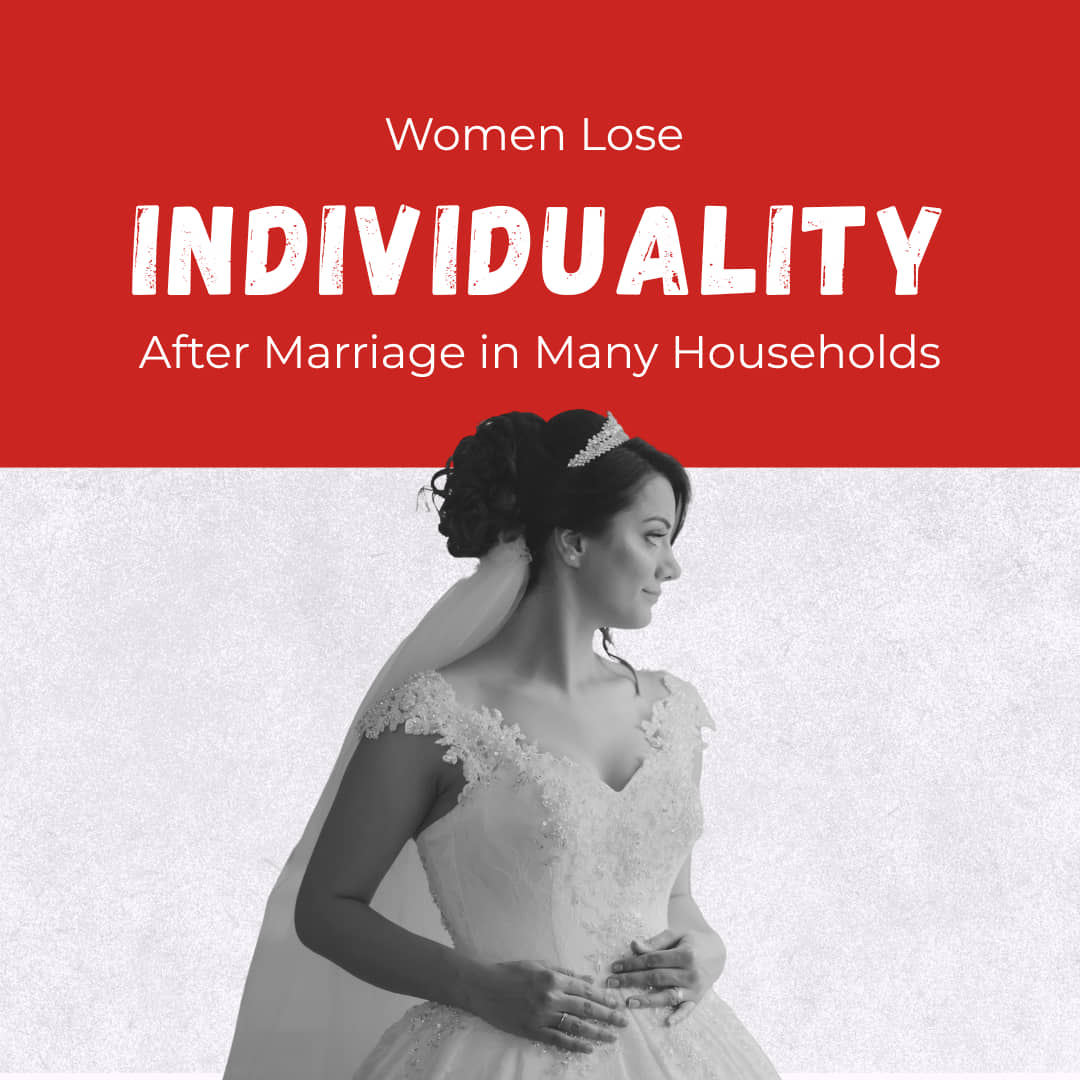
Overview:
- Marriage brings unspoken rules that slowly replace who she is.
- Her choices, hobbies, and ambitions quietly take a back seat.
- Seeking permission for basic decisions becomes her new normal.
- Reclaiming her identity is possible, but it takes time and support.
Marriage is often celebrated as the beginning of a new life. But for many women, it becomes the beginning of constant adjustment. A woman walked into her new house carrying more than her luggage after her marriage. She carried years of her own becoming: the person she has built through her friendships, education, opinions, and Saturday rituals.
Then, gradually, without anyone sitting her down to explain what was happening, she began to disappear. Not all at once but just in pieces. She one day caught her reflection and felt like she was looking at a stranger.
Women losing individuality after marriage is one of the most common yet least discussed transformations in life. It does not always appear to be oppression from the outside. Because it is more of an adjustment, a sacrifice, and being a good daughter-in-law. But a woman is quietly handing over the most personal parts of herself underneath those polished labels.
She Married Into a Rulebook She Never Agreed To
Every family that has lived together for years develops its own culture. They have a particular way of doing things like when meals are served, what topics are appropriate at the dinner table, and what tone is acceptable in conversation. These rhythms exist long before the new bride arrives. But suddenly, in the blink of an eye, she is expected to fall into them without disrupting a single note.
There is no manual given to her for all this. The rules come through indirect signals. It can be a remark about the way she seasoned the food. Sometimes, it appears as a pointed observation about how her mother does things differently.
Over time, she stops guessing and simply conforms. Women’s identity after marriage often starts fading. These tiny moments of correction feel pressure, and nobody calls it that way.
She Stopped Recognizing Her Own Choices
Before she knew it, her morning routine had been replaced by the household’s. The food starts tasting like someone else’s preferences. The clothes are picked with the family’s expectations in mind rather than her own comfort. Even the way she laughed, a little too loudly, apparently got quietly toned down.
Many women describe this period as losing a language. The language of their own likes, dislikes, habits, and choices. The hobbies they once loved got abandoned, and the old friendships faded because time simply ran out. This often mirrors the emotional cost of always being available. Everything that once felt personal slowly stopped being theirs.
Household expectations of women rarely demand anything dramatic. They demand compliance in small, repeated doses. And it is precisely because each instance seems so minor that the full weight of it rarely registers until much later.

Image Credit: Unsplash
When Did Stepping Out Become a Negotiation?
There is something deeply disorienting about having to ask another adult for permission to step out of your own home. Yet this is the lived experience of many married women, particularly in joint family setups. Even a visit to her own parents requires discussion. Spending her own earned money requires a conversation that she is not always sure she will win.
This is not always framed as control. It often comes dressed as concern and unsaid rules. “Who will you go with?” or “Why do you need to go alone?” are questions that sound caring on the surface. However, they quietly communicate that her independent movement through the world is conditional.
Over time, she begins pre-screening her own decisions before even the voices. She skips wanting things that feel too complicated to ask for. Women losing individuality after marriage often accelerates here, in this gradual shrinking of her right to simply exist without seeking clearance.
“You Can Pursue It Later,” And Later Never Came
In some households, a woman’s ambitions like her career, studies, or a skill she wanted to develop, come up against an invisible ceiling after marriage. The family does not always say no outright. They say “later.” Later, when the children are older or when things settle down. And later, as most women discover, it is a door that never quite opens.
The woman who once had her eyes set on a postgraduate degree quietly stops mentioning it. She internalizes the message that her aspirations are a personal indulgence to the family. Women’s identity after marriage takes one of its heaviest hits here, in the professional and intellectual space. When she cannot grow in those areas, her dependence deepens, and the sense of self quietly shrinks along with it.

Image Credit: Pixaby
The Loneliness Nobody Talks About
There is a particular kind of loneliness in being surrounded by people who need you and still feeling entirely unseen. Many women in restrictive marriages live inside this contradiction every day. They manage the household, raise the children, care for the in-laws, and show up for every family occasion. But inside carrying a feeling with no room for their own life.
This grief does not always look like sadness. Sometimes it looks like exhaustion that sleep does not fix. It becomes more like irritability that everyone around her attributes to hormones or mood. Household expectations of women rarely leave space for her to name them. And so she learns to adjust, endure, and keep showing up.
The Long Road Back to Who She Was
Change rarely arrives dramatically. For most women, it starts in stolen moments. A quiet afternoon spent writing. A course pursued after the house goes to sleep. A phone call with an old friend who still remembers who she was. None of these feels like big moves. But each one is a small step back to herself.
A spouse who actively supports his wife’s individuality changes everything. A husband who encourages his wife to pursue what she loves changes the entire equation. When she is allowed to hold on to her own goals, the marriage becomes a partnership rather than an institution she must disappear into.
More women are also beginning to speak about this experience openly by naming what they lost, asking what can be reclaimed. They are building communities where those conversations are no longer considered complaints. Women losing individuality after marriage is, finally, a subject that is getting the honest attention it deserves.
Conclusion
Marriage asks a great deal from both people who enter into it. But for far too many women, it asks for the most personal thing of all, themselves. A household gains nothing lasting from a woman who has been hollowed out by expectation.
Women’s identity after marriage should not be something that quietly disappears because a family decided long before she arrived who she was supposed to be. Every woman who walks into a new home carries with her a life that was entirely her own. That life deserves to continue.
