
CATEGORIES
Leadership & Impact | LGBTQIA+ | People We AdmireOverview:
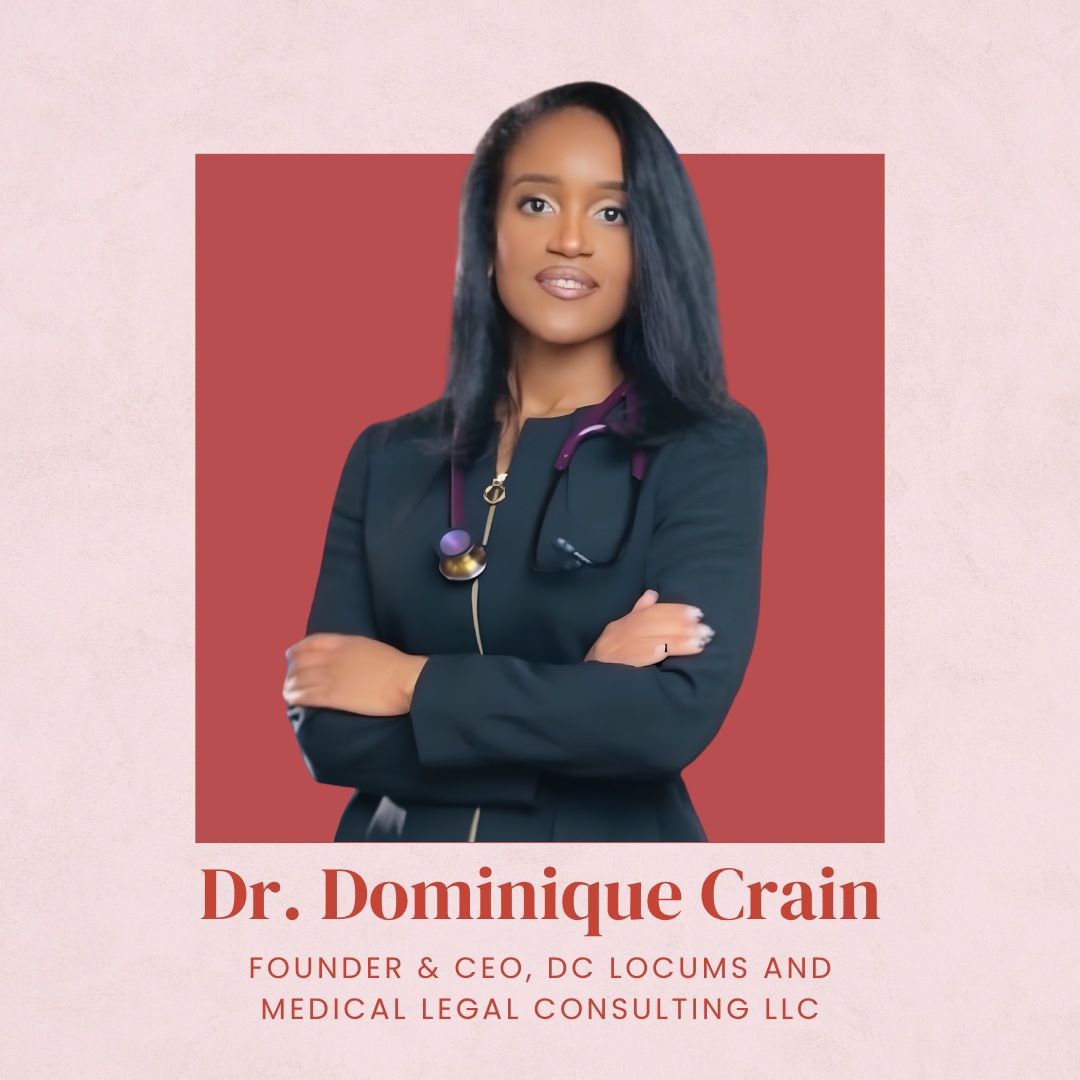
- Dr. Dominique Crain decided she was going to be a doctor at five years old, and never once looked back.
- Now a hospitalist across more than a dozen healthcare systems, she’s built a medical-legal consulting practice that reflects her values beyond a medic.
- Her leadership style rejects hierarchy altogether, built instead on trust, collaboration, and the conviction that every voice in the room carries weight.
- In this conversation, she talks about persistence and the need to stay human in a field that often forgets to.
1. You’ve built a career practicing as a hospitalist across more than a dozen healthcare systems while also developing a medical-legal consulting practice. Could you tell us about your professional journey and what inspired you to bridge clinical medicine with expert medical consulting?
My decision to become a physician was made when I was five years old. I come from a military family. My mother was active duty in the Air Force, and she was medically retired around that time. I remember the constant visits to doctors’ offices and, at times, emergency rooms because of the acute illnesses she was experiencing. Watching the care she received from healthcare personnel in military hospitals stayed with me.
The defining moment was when my mother received notification that she was rated a 100% disabled military veteran, after years of hospital visits, tests, and labs. I told her, “I want to be able to help others as others have helped you,” and from that point on, the decision was made.
By high school, I was shadowing in clinical practices through volunteer and summer programs. I studied at the University of South Alabama for both my pre-med program and medical school, then completed my residency at the University of Alabama in Tuscaloosa, graduating in 2020, right at the height of the pandemic. Jobs were scarce that summer, so when I finally found one, I saved enough to eventually build my own independent practice.
That independence led me into travel medicine, so I could experience different healthcare systems across the country. I’m based in Atlanta, but my work has taken me as far as Hawaii. Along the way, I witnessed enough gaps in patient rights, patient advocacy, and healthcare worker safety to know I wanted to do something about it. My core belief is that poor outcomes are almost never an individual failure—they’re systemic. My goal in medical-legal consulting is to look at the whole forest, not just one tree, and help build better practices from that understanding.
2. Many physicians hesitate to step into entrepreneurship. What were some of the biggest challenges you faced in transitioning from practicing medicine to leading your own company, and what lessons did you learn along the way?
The biggest challenge has been managing the business side of medicine. Even six years in, it’s an ongoing learning process, navigating taxes, digital marketing, client outreach, and lead generation. Referrals are what keep my business going. With every client, I give between six and twelve months of engagement, and toward the end of that tenure, I humbly ask for a review. I also stay in close contact with my recruiting partners, because that rapport builds a stronger network for future outreach.
3. As the founder of DC Locums and Medical Legal Consulting and an expert in evaluating inpatient standards of care, how has your experience working across diverse hospital systems influenced the way you assess complex medical cases and contribute to improving healthcare accountability?
I’ve learned that nothing in healthcare is cookie-cutter. Every system has its own challenges, and exposure to different environments lets me both educate myself on varying practices and act on what I learn. Clients often ask me how other institutions handle things — sepsis identification, root cause analysis, error prevention — because one of my clients has been to Stanford University, and there’s a lot to draw from that experience. Every engagement gives me something to bring back into my own practice and pass along to the next client I serve.
4. Throughout your career, you’ve collaborated with healthcare institutions nationwide. What leadership qualities have been most important in building trust and driving collaboration?
I see leadership as an even field between leading and following. I’m still early in my career, and much of what I’ve gained has come from watching more experienced physicians model exemplary service and dedication. When I’m on a clinical team, I don’t believe in hierarchy — whether you’re an RN, PA, NP, or MA, we’re all at the same level, and everyone has something to contribute. I believe in a collaborative team system, not a top-down one. Encouraging that kind of even ground is, in itself, a leadership skill — it helps people speak up, stay confident, and stay focused on providing safe, evidence-based care. Sometimes it takes multiple perspectives to shift a culture toward better outcomes.
5. What is your long-term vision for DC Locums and Medical Legal Consulting, and what advice would you give to physicians who want to create meaningful change in the field?
My long-term goal is to promote outreach to communities near and far, and to encourage women to step into leadership — whatever that looks like for them — and bring others along with them. On the medical-legal side, I want to change the culture between law and medicine so the two fields stop working against each other. At the end of the day, our service is to our communities, and we need to move past toxicity, implicit bias, and the labeling of one field against the other. I’m over that toxicity, honestly.
6. What’s a common misconception people have about being a doctor that you’d love to clear up?
That we’re robots. We’re human, and not all of us fit the self-aggrandizing stereotype, even though elitism does show up in medicine sometimes. I remind my colleagues often — it doesn’t matter if you’re the top brain surgeon in the country, you still have a heartbeat, and you need to act like it. Compassion, humility, honesty, and integrity matter just as much as clinical skill.
7. You’ve worked in so many different healthcare settings. Is there a patient interaction or experience that has stayed with you over the years?
I was working in Mobile, Alabama, when a patient came in with progressive, unrelenting headaches. She’d already been treated with standard migraine cocktails and was ready to be discharged, but she declined and asked to speak with another physician. I took her case during a 24-hour call and something told me to order an MRA and CT angiogram of her brain. It turned out she had meningitis, encephalitis, and a blood clot. My hospital couldn’t provide the level of care she needed due to staffing and capacity, so after hours of escalating the case, I managed to get her transferred to a facility that could take her. That 24-hour shift became 42 hours, and I went home and cried that night, not knowing if she’d survive. Our paths met once more two months later through a mutual connection and I got to know that she has recovered-such an unexpected turn of events. That case reminds me why persistence in patient advocacy matters, even when the system makes it difficult.
8. Medicine is demanding. What do you enjoy doing to recharge when you’re off the clock?
I run half and full marathons. I’m currently training for one on Halloween, and I’m a member of the Atlanta Track Club, which is 40,000 members strong. Staying active keeps me engaged with my community while keeping my own body and energy in check — because if I want to promote health and wellness for my patients, I can’t just talk the talk. I have to walk the walk, or in this case, run the marathon.
Off the clock, I’m also deep into an 18th-century France obsession — reading up on the French Revolution, Marie Antoinette, and the Sun King, and slowly teaching myself French so that next time I’m in Paris, I’ll actually understand what’s being said around me. When I retire around 60, I want a small apartment in Paris and a seat in an orchestra.
9. What book, podcast, or resource has influenced your thinking recently?
‘Atomic Habits’ by James Clear and ‘Profit First’ by Michael Michalowicz. I’ve also read Michelle Obama’s ‘Becoming’, and I regularly listen to self-help and empowerment-focused podcasts. Every day is a challenge, and we all need reminding of the power we already hold, myself included. I’ve had moments of self-doubt and imposter syndrome too, and it’s up to me to keep doing the work to move past them.
Conclusion
Dr. Dominique Crain’s story is proof that medicine and entrepreneurship don’t have to sit at odds. From a five-year-old watching her mother’s hospital visits to a hospitalist and consultant reshaping how healthcare systems hold themselves accountable, her path reflects persistence, humility, and a refusal to separate her humanity from her expertise.
