
CATEGORIES
Leadership & Impact | People We Admire | TechnologyOverview:
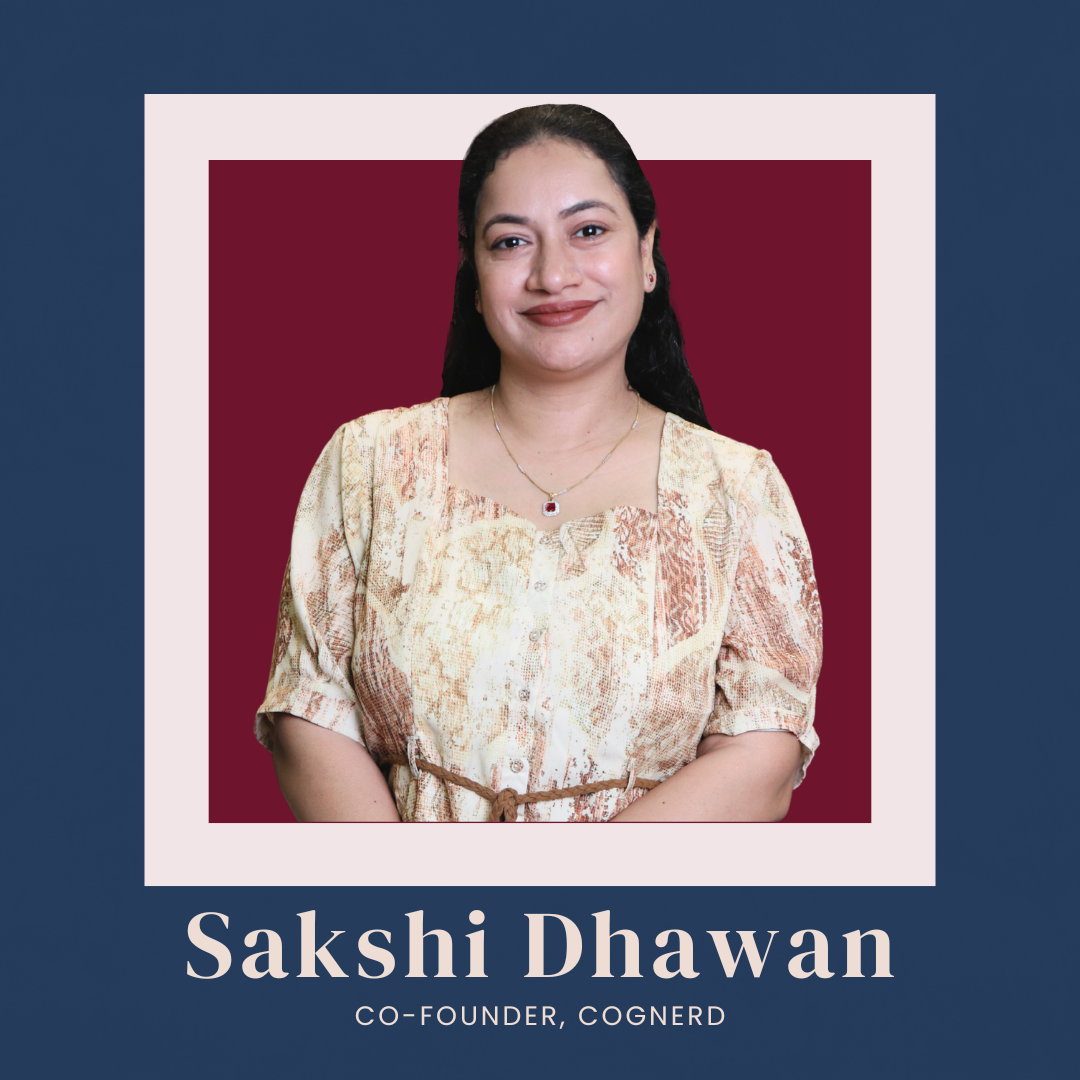
- Sakshi Dhawan’s journey is driven by one thing that has never changed: a need to understand why people do what they do.
- With a background spanning engineering, sales, neuromarketing, and a PhD in neuroscience, her career has always followed curiosity across disciplines rather than a single straight path.
- Her work sits at the intersection of human behavior, technology, and business visibility.
- Today, she channels that interdisciplinary thinking into Cognerd, helping businesses get found in an AI-first world.
- In this conversation, she reflects on decision-making, the science of human attention, and what it really means to build something with purpose.
1. When you think back to your childhood, what were you naturally curious about? Were there any early signs that you would get into what you are doing right now?
I was a very curious child. I would think about a lot of things, but especially I had a lot of questions about religion and spirituality. Like, is there a God? And if I could go and ask Him, I would say, ” Okay, if you are God, then who is the one who made you?” I constantly found myself caught in cycles of questioning, always trying to trace everything back to its ultimate source.
I think that’s how I approach a lot of questions in my life as well. If A is happening, why is A happening, what was behind it, and so on. That causation chain always intrigued me about people, as well as other things. So yeah, I’d say I’m still very curious about things.
2. Your path has taken you from sales in India to neuroscience research in the US and now entrepreneurship. Looking back, what threads connect all those chapters?
I believe everything I have done is very much connected. There is nothing in my life that I have done so far that I haven’t ended up using or implementing in some way or another. Considering my engineering background, then sales and marketing, and now coming into the consumer behavior side of neuroscience, I think to solve any real-world business problem, you need an interdisciplinary perspective. And to get that, you have to be exposed to different kinds of lenses.
When I look back, all the things I’ve done across different domains actually helped me solve problems in a much more holistic manner. Bringing all those experiences together is what actually works in business; it enables me to approach problems from different angles.
3. Is entrepreneurship something you always saw yourself doing? Now that you have it, how does it feel?
I have family members in business as well, so perhaps the entrepreneurial DNA was always there. But I never really thought about it much when I was pursuing my education or working in jobs. I think sometimes life takes you down different routes, toward something you’re actually meant to do. And I just trusted the process a lot.
4. You’ve spent years studying how people think, how they behave, and how they decide where to pay attention. Was there a particular insight that fundamentally changed how you understand human behavior?
My first real experience with this was during my MBA, when I was specializing in marketing and realized how much advertising affects behavior which built my understanding that I am not making purely rational, individual decisions. I’m biased by a lot of subliminal cues and exposure to things happening around me. What fascinated me was the idea that your own decisions can be influenced by so many factors in your environment.
From there, I moved into sales and worked in field sales for about a year, speaking to dealers and people. That gave me real insight into how people think, especially when they’re deciding whether to buy something, and what techniques or methods you have to use to convince them it’s a good investment which fueled even more curiosity in me.
Then I moved into neuromarketing, which made me think, ‘this is it.’ You can use tools like eye tracking to figure out where people are looking on a screen or what product they’re focusing on in a supermarket. There’s still so much I’m learning, and I’m surprised by how people behave.
One concept I find especially interesting is the hot-and-cold empathy gap, the idea that when you’re in an angry or “hot” emotional state, you can’t accurately predict how you’d behave in a calm or “cold” state, and vice versa. We like to think we can predict our own behavior really well but the situation you’re actually in defines how you’re going to act. That’s why I don’t think people are ever as rational as they’d like to believe.
5. What made you decide to take those research insights beyond academia and build something out of them?
My last stop in academia was my PhD. A lot of people assume the traditional next step after a PhD is either academia or a corporate research role, but I’ve always thought a PhD and entrepreneurship are very similar; they both require a lot of perseverance. You have to genuinely care about the problem you’re solving and want a meaningful solution that actually makes a difference. So for me, the transition felt very natural.
Even in my business now, I think from a research perspective. I like to generate a hypothesis first, figure out what will work and what won’t, then experiment with different solutions to find what actually helps solve the problem. I still follow the methodology I learned in academia: how to approach a problem and understand every part of it. Academia really helps you develop critical thinking, and I think that’s been a huge part of what I bring to what I’m doing now.
6. When did you realize that AI-powered discovery was more than just another piece of tech, that it was going to fundamentally change how people find information?
This realization came last year, when I moved back to India and started thinking about my next step. I started collaborating with a friend who was already exploring a key question: how do businesses become visible on AI platforms? As I dug deeper into the research, I questioned why this challenge was important and how it differed from traditional SEO. My research showed that while numerous startups in the US and Europe were actively developing solutions for AI platform visibility, the market in India was still largely nascent at that point, and there were no established players focused on this problem.
Then there was a case involving IndiaMART, where they raised concerns about how competitors showing up instead on AI platforms was actually affecting their business. That really drove home how this isn’t just theoretical anymore; it’s impacting real businesses right now. In just the last six months, AI discovery has become something businesses genuinely cannot ignore. If you’re not showing up on AI, you’re losing customers. You might have been able to get by without it before, but now, if you’re not there, you’re nowhere.
Even something as simple as how people use Google now shows this shift; most people don’t scroll past the AI-generated summary anymore. We want a synthesized answer, not five different websites to sort through ourselves. We’re moving into a zero-click era, and there’s a real trust that’s built around it: people see an answer and move forward, basing decisions on it. I think that’s also tied to shorter attention spans with social media, but every new phase of technology brings its own trade-offs, and we just have to learn to adapt to both sides.
7. When you and your co-founder officially founded Cognerd, what were the main problems you were determined to solve?
My co-founder, Aman, already had a separate business he was building on his own, and as part of that, he needed to do digital marketing to get visibility. That’s when he realized he wanted to automate the process, and that’s really where the AI visibility problem first came up for him. I joined a bit later, after I moved back, and once I got involved, we realized we had real synergy and could actually build something meaningful together.
When we officially founded Cognerd, the biggest problem we saw, especially in India, was that people simply weren’t aware of AEO. They understood standard digital marketing, performance marketing, SEO, and social media posting, but they didn’t understand why visibility on AI platforms mattered. Beyond raising that awareness, we also wanted to help local businesses compete with global competitors who had already started building in this space. So we built a product to help organizations and digital marketing agencies get visible on AI platforms for themselves and their clients.
8. As AI increasingly shapes how people discover information, what excites and concerns you most about the future of human attention and trust?
What excites me is the disruption happening right now. I recently met someone in his 80s who was genuinely excited by tools like Claude, Gemini, and ChatGPT. He relies on them every day, asking questions about his business and daily life. Seeing people of all ages exploring these platforms with that same curiosity is really inspiring to me.
What concerns me a bit is the over-reliance I’m seeing across many sectors, among software engineers, students, educators, and other professionals. These platforms can hallucinate, and not everything you get back is accurate or fact-based. I hear people say things like, “I can’t write an email anymore, I just have ChatGPT do it.” I understand the appeal; it saves time on something that could otherwise take a while, but somewhere along the way, we risk losing critical thinking.
It’s the same with attention. Our attention spans are getting shorter, and if we keep relying on these platforms for everything, we may lose the ability to generate new ideas. I struggle with this myself sometimes. I really have to sit with my own thinking now, because there’s so much information constantly coming at me that it’s easy to lose track of what I actually think versus what I’m being told to think. I believe using AI with a conscience is something we all need to practice. Relying on it for every small thing isn’t sustainable in the long run. There’s always a trade-off, whether it’s monetary or something deeper, like how you think and how you behave.
9. You’ve been a researcher, an educator, and now a founder. What’s a leadership lesson you’ve learned that you genuinely enjoy passing on to others?
One lesson that has always resonated with me and one I needed when I was being mentored is that high expectations should always be paired with strong support. As a founder now with my own team, it’s easy to have high expectations of what the team should be doing or what our goals are without stopping to think about what kind of support or resources they actually need to meet those expectations.
People don’t always realize how much potential they have, and sometimes they just need a little nudge in the right direction. But if they don’t have the resources to back that up, they may never be able to reach it. So I really believe a good support system is essential if you want people to grow and reach new heights.
10. What advice would you give to someone figuring out their path, especially if it doesn’t feel linear?
A degree doesn’t define you; you can do great things without one, too. I say that even with a PhD myself. Especially now, with AI helping people learn so much on their own, whether or not you choose to pursue a formal degree is a personal choice. One thing people don’t always think about is that you don’t have to study purely as a means to get a job; sometimes you study because you genuinely enjoy the process of learning, and a lot of people don’t see it that way.
What you study isn’t necessarily what you’re supposed to do next. For some people, it works out as a clean, linear path, and that’s great. For others, it takes trying many different things before landing on what actually fits. I think all paths are equally valid. You have one life; you should be able to try as many things as possible, just for the experience. What’s the worst that happens? You fail, but you learn from it, you gain experience, and you walk away with a story to tell.
There’s also something to the science of this. When you’re in a really difficult stretch and feeling every bit of it, five years down the line, you usually don’t remember it as quite that bad. We tend to forget difficult memories more easily, which I think is actually a kind of blessing. When you’re in it, it’s hard to see a way out. But trust me, years later, you look back and realize you got through it and you’re still doing well. I do think struggle builds character, not to romanticize it, but going through hard times genuinely teaches you a lot about life.
11. When you think about the impact you hope to create through Cognerd, or the legacy you’d like to leave behind, what comes to mind?
That’s a question I’d honestly need more time to sit with. I haven’t thought deeply about the kind of legacy I want to leave, because I still feel like there’s so much left to learn, and hopefully a long life ahead where I get to try a lot more things. But if there’s one thing that truly matters to me, it’s having purpose, working on something that genuinely matters and creates real impact in people’s lives. If someone thinks back on me someday, I’d want them to think of me as part of something there that really mattered.
