
CATEGORIES
#Careers #Technology #Work CultureOverview:
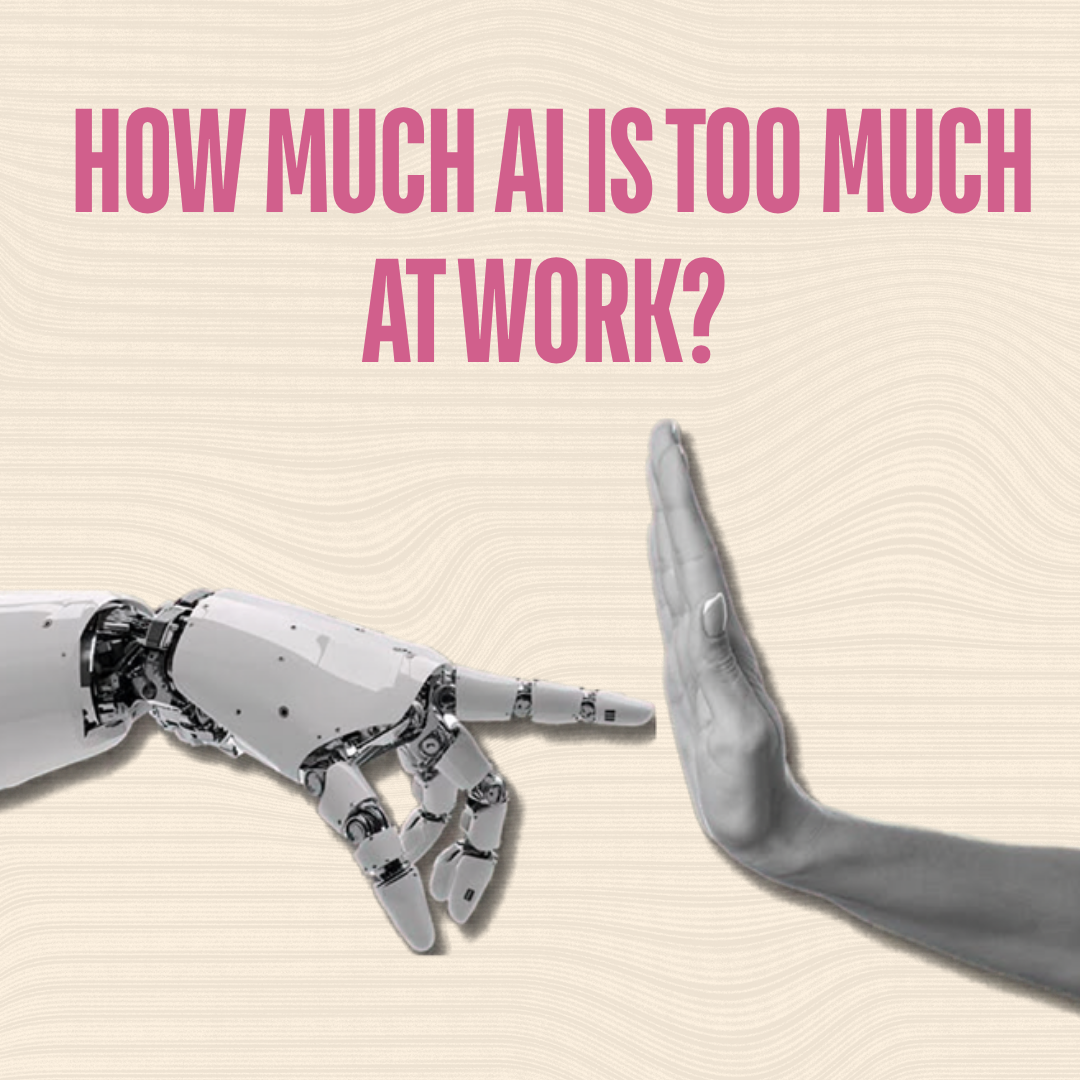
- How much AI is too much depends on whether it improves your decisions and your work, not on how often you use it.
- Research shows real gains on some tasks, but performance can drop when a task falls outside what AI does well.
- Warning signs include accepting answers without checking them, missing errors you know how to catch, and assuming faster means better.
- Evidence on creativity and teamwork is still early, so concerns should be treated as open questions rather than proven facts.
- A healthy balance comes from checking important outputs, measuring quality over speed, protecting confidential data, and staying accountable for what you produce.
When artificial intelligence doesn’t add value to your decision-making process, it creates too much of a burden. The frequency of use is not a good indicator of its effectiveness. An individual who utilizes artificial intelligence on a daily basis and reviews each result might be making good use of it. Someone who uses it just twice a week but accepts every answer without fact checking may be relying on it too much.
The better question is whether you verify what it gives you before you act on it. That also lets you spot mistakes and produce better work rather than just finishing faster. It’s also important to know who is accountable for the incorrect work. The findings of such research are valuable, but are still developing, so treat its result as a guide.
When Is AI Actually Helping You at Work?
While AI is beneficial in performing repetitive, predictable tasks, the impact is subject to individual and task-specific contexts. One study published in the Quarterly Journal of Economics looked at 5,172 customer-support agents at a software firm. Using an AI assistant boosted the number of issues agents closed by approximately 15% on average. These speed gains were largest for less experienced workers and smaller for the most experienced workers. A few measures of quality showed a slight drop for the most experienced workers.
It is a useful finding with its limitations. It covers just one company and one type of job, so it can’t be applied to all workplaces. It also illustrates why the terms speed and quality should not be used interchangeably.
Researchers discovered that users of GPT-4 finished 12.2% more tasks and were 25.1% faster. They were also able to produce higher-quality output on tasks that GPT-4 was able to perform. The researchers also discovered that performance would degrade if a task was not in those abilities. But, these tools can assist, and the job still counts.
What Are the Signs You Are Relying on AI Too Much?
A sign is if someone accepts an answer without questioning if it is correct. The researcher experiment showed that AI users were less likely to arrive at the right answer. This happened when they had to do something where artificial intelligence was not able to. AI didn’t just make errors, it made them unforgivable. People could believe what it was when they had a reason to doubt it.
One of these red flags is believing that artificial intelligence tools save time merely because it is quicker. METR conducted a randomized trial of 16 experienced developers implementing 246 tasks on their own projects. They found that when they were allowed to utilize artificial intelligence tools, they spent 19% longer. This was despite their expectation that they would be approximately 20% quicker. In the study, they were using a small sample and tools that were available early in 2025. So it’s not representative of the impact that these tools have on all users. It does illustrate that there is a gap between what is perceived as being productive and what is truly productive.

A related question is raised from the critical thinking research. A recent Microsoft & Carnegie Mellon study involved 319 knowledge workers. The study revealed that people more confident in AI’s capabilities reported less critical thinking about their work. The survey was designed to take people’s reports on one occasion. It can’t demonstrate that Artificial Intelligence is eroding the ability to think critically, or deny other factors.
Also in practice, the red flags are: unable to describe how an answer was correct. Others are failing to detect an error that you know how to check for. Another is not knowing what certain tasks you are doing poorly don’t work well on the tool. These are good, albeit not scientifically determined, thresholds for overuse.
Can Too Much AI Affect How Teams Work Together?
Artificial intelligence can assist individuals create concepts, but it can also create more similar concepts. The scientists published their results in the journal Science Advances. The experiment found writers using the AI-generated ideas were able to write shorter stories. The stories were judged more creative and more well-written. This was particularly true for writers who didn’t score high enough on their creativity without artificial intelligence. The stories were, however, more akin to each other. This study focused on short stories, rather than on extended collaboration in the workplace. So the results should not be seen as evidence for the belief that AI diminishes creativity in all teams.
A field experiment involved 776 professionals at Procter & Gamble. Those who used artificial intelligence tools were as effective as those who worked in teams of two. Those teams worked without the help of these tools in the tasks investigated. This group also experienced more positive and fewer negative emotions for the artificial intelligence group. The findings indicate that there is potential for AI to enable certain forms of collaboration. But they do not shed light on the long-term impact of artificial intelligence on workplace relationships.
There is limited evidence regarding potential long-term impacts of artificial intelligence on trust, feedback and mentoring. Those worries are just as valid, and should not be stated as a fact.
How Can You Find the Right Balance?
- Use the appropriate tools for the job. Be more careful when it requires a degree of specialization or if a wrong answer would have serious consequences. Use AI when you can assess the answer yourself.
- Monitor outputs that are important. Check facts, data and conclusions before presenting them. Confidence does not equal correctness!
- Take quality not speed of measurement. Evaluate the quality of the work, not how quickly it has been done. Look at it in terms of accuracy, usefulness and appropriateness for the purpose.
- Think first before you prompt. When originality is important, make up your own thinking. It’s a helpful measure. It’s not an accurate way of guaranteeing that AI will not come up with the same output in all tasks.
- Protect confidential information. The processing of personal data in the context of generative AI continues to be subject of Data Protection Law. The UK Information Commissioner’s Office states this. The risk is based on the tool, tool setting, information used and your organisation’s rules. Do not enter personal or confidential information without first reading the rules.
- Implement and adhere to work policies and engage people in issues that relate to them. While AI can help with information preparation and/or message drafting. Hiring, feedback, and handling conflict in the workplace is a matter of human judgment.
Conclusion
When people remain responsible for the work they can produce with artificial intelligence tools, it will be most useful. Artificial intelligence tools will be most useful when people remain responsible for the work they can produce with them. Use these tools where they help, fact check over the answers and evaluate based on quality not speed. The current research neither suggests that we need to fear artificial intelligence. Nor does it suggest that we should use artificial intelligence tools to solve all our problems. It provides an opening for a more conscious use. Know the limitations of the instrument and be responsible for what you put out.
