
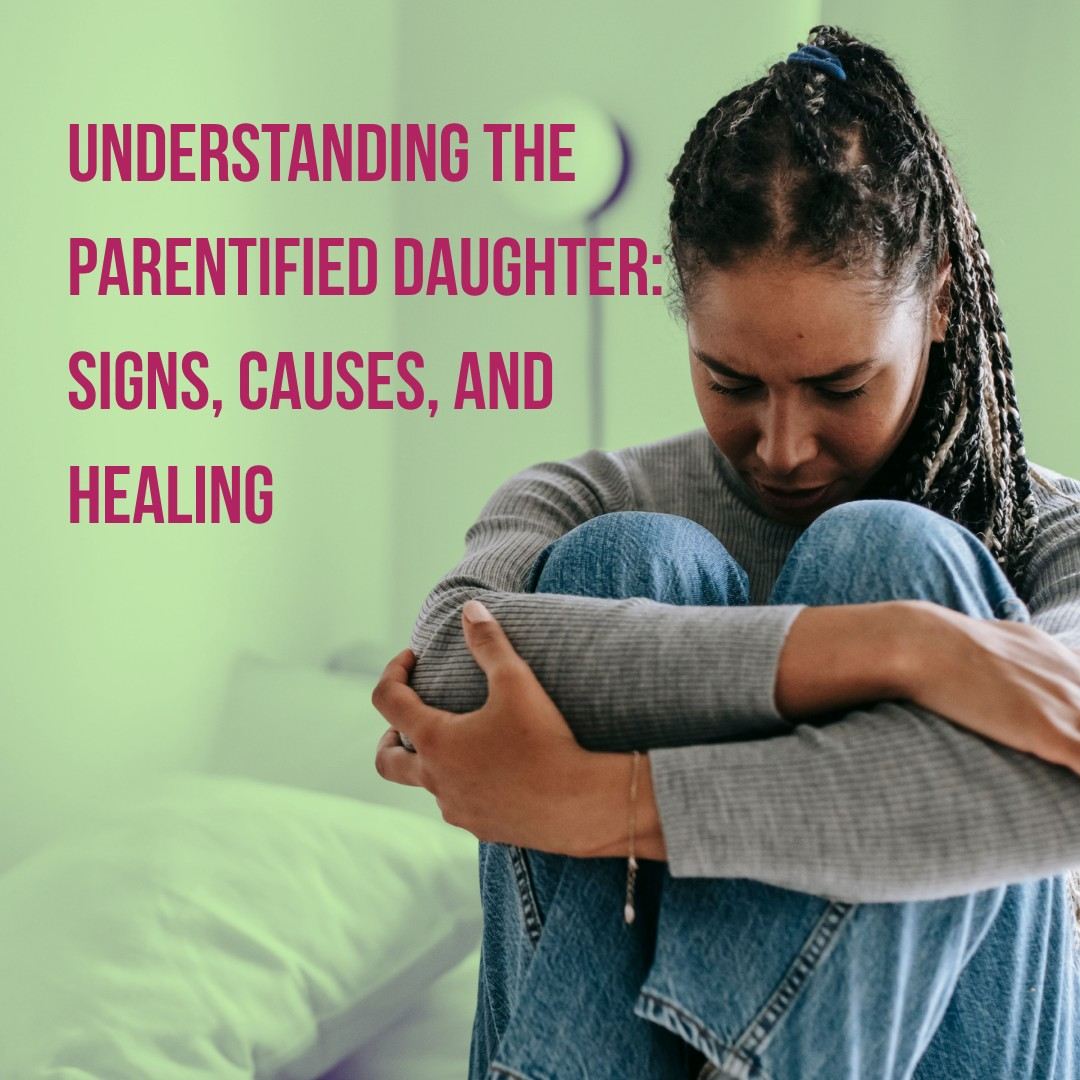
Overview:
- A parentified daughter’s early trauma associated with the home setting affects her sense of self and identity.
- She sacrifices her desires and limits until she burns out in order to put everyone around her at ease.
- This tiredness can be annoying and frequently shows up in both personal and professional spheres.
- Understanding signs, triggers and trauma responses is the first step to acknowledging and healing with support.
- Recovering from trauma reactions may require a great deal of self-compassion, patience, support and grace.
Introduction
On some days it looks like responsibility; on others, it looks like a weight on your shoulders that can crush your spirit. You were nine and already fluent in everyone’s silences. You knew your mother’s exhaustion by the sound of her keys hitting the table before she’d even opened her mouth. You knew your father’s temper by the weight of his footsteps on the stairs. Nobody taught you this. Nobody sat you down and said, learn to read a room before you learn to read a book. But you did it anyway. You had to.
They called it maturity. They called it being a good girl, a responsible girl, a guardian sibling. Nobody called it work. Nobody said, this is your first job, and there’s no salary, no leave, no manager to complain to, just Sundays that stopped feeling like Sundays somewhere around age eight. You grew up standing guard over other people’s feelings, and somewhere along the way, you forgot to ask what your own were doing. This is not a personality. It’s a pattern. And patterns, unlike personalities, can be unlearned.

What Parentification Actually Means
Parentification is what happens when a child takes on responsibilities that belong to an adult, long before she has the tools or the years to carry them. Psychologists usually split it into two kinds. Instrumental parentification looks practical: managing the household, paying bills, caring for younger siblings, translating for parents who don’t speak the local language fluently. Emotional parentification is quieter and harder to name. It shows up as being your mother’s confidante, your father’s peacekeeper, the family’s designated fixer of moods and moments.
Daughters carry more of this than sons, and that is not a coincidence. Most cultures, including ours, hand girls an early apprenticeship in caregiving. She is praised for being “mature for her age,” for being “the sensible one,” for holding the house together while everyone else is allowed to fall apart. The praise feels good. It also quietly teaches her that her worth is tied to how much she can carry.

How It Begins
Parentification rarely starts as a single dramatic event. It builds slowly, out of ordinary circumstances that ask a child to grow up faster than she should. A parent’s illness, physical or mental, can push a daughter into a caregiving role years before she is ready. Financial strain does something similar, turning a teenager into an unofficial second income or an emotional buffer against her parents’ stress. Divorce, migration, and loss can also leave a vacancy that a child, often the eldest daughter, ends up filling.
Parentification can be especially common among eldest daughters who take on adult responsibilities early. Understanding parentification in eldest daughters can help explain how these responsibilities affect emotional well-being.
Cultural expectation adds another layer specific to South Asian families. The eldest daughter is frequently positioned as the second mother of the house, especially if there are younger siblings. This is rarely announced outright. It is absorbed through small, repeated moments: being asked to skip an outing to watch a sibling, being the one whose opinion is sought about family decisions while still in school, being told she is “wise beyond her years” as though that were only a compliment and not also a quiet forfeiture of childhood.
The Signs She Might Not Recognize
A parentified daughter often does not see her own pattern until much later, usually in her twenties or thirties, when the habits she built for survival begin surfacing in places they no longer belong. What once kept a household running quietly reappears now as reflexes she cannot fully explain, in a boardroom, on a first date, in the space of an ordinary evening when nobody has actually asked anything of her at all.
The Guilt Underneath Rest
She may find it difficult to ask for help, having spent years being the one who provides it. Needing something from someone else can feel unfamiliar, even faintly embarrassing, as though it exposes a weakness she was never allowed to have growing up. Rest carries its own quiet tax too. She may feel a low hum of guilt whenever she slows down, as though stillness itself is a kind of negligence, a debt quietly accruing somewhere she cannot quite see. A free Sunday afternoon can leave her more unsettled than an actual emergency would, because an emergency at least gives her something to do with her hands.
Caretaking as a Reflex
In relationships, she often becomes the caretaker by default, drawn to people who need fixing, because tending to someone else’s needs feels more familiar than naming her own. She may find herself managing a partner’s moods the way she once managed a parent’s, softening conflict before it fully arrives, reading tension in a room the way other people read the weather. Friendships can follow a similar script, with her cast permanently as the dependable one, the one who remembers birthdays and shows up with soup, rarely the one who gets asked how she is actually holding up.
A Fractured Sense of Self
She may also struggle with a fractured sense of identity and a quietly diminished self-esteem. Research on parentification has repeatedly linked both its emotional and practical forms to lower self-worth in the people who carry them, a pattern often traced back to years spent measuring one’s value through usefulness rather than simply through being. When so much of her early life was defined by what she did for others, she can reach adulthood unsure of what she actually wants, separate from what is expected of her. Ask her what she would choose on an ordinary free evening, with no one else’s preferences to account for, and she may genuinely not know where to begin.
The Need to Control What Cannot Be Controlled
A quiet need for control is common too. Having grown up managing chaos, she may feel unsettled by situations she cannot organize or predict, even small ones that shouldn’t matter this much: a delayed flight, an unplanned change of dinner plans, a friend who cancels without much notice. This is not rigidity for its own sake. It is what happens when a nervous system learns early that vigilance is safer than surprise.
None of this makes her fragile. It makes her someone who adapted well to circumstances that asked too much of her too early. The adaptation was intelligent. It was just never meant to be permanent.
Towards Healing
Healing from parentification does not mean rejecting the parts of her that are capable, responsible, or attentive. Those qualities are real and often genuinely valuable. It means learning that she is allowed to set them down sometimes, that her worth does not evaporate the moment she stops managing everyone around her.
A kickstart to gain momentum is naming the pattern itself. Simply recognizing “I was parentified” can loosen the grip of guilt that so often accompanies rest or boundary-setting. Therapy, particularly approaches that work with the inner child, can help her separate the girl who had no choice from the woman who now does. Journaling can do quieter versions of the same work, offering a private space to ask what she actually feels, apart from what she has always managed for others.
Boundaries matter too, especially with family. This does not require confrontation or estrangement. It can be as simple as choosing not to mediate every argument at home, or letting a sibling solve their own problem without stepping in first. Each small refusal to over-function is also a small act of reclaiming what was taken early.
Healing from parentification often involves understanding how family experiences shape emotional well-being. Learning about family trauma and healing can help you recognize unhealthy patterns and begin building healthier relationships.

Personal Reflections
Perhaps most importantly, healing asks her to build relationships, romantic, platonic, and familial, where care moves both ways. Where someone asks how she is doing and actually waits to hear the answer.
The parentified daughter spent years being the strong one, so her family could function. She deserves, at some point, to simply be a daughter again, allowed to need things, allowed to be held instead of always holding.
If this piece feels close to home, we would love to hear what it stirred up for you. Write to us. We read every message.
Conclusion
The parentified daughter spent years holding her family together before anyone thought to ask if she wanted the job. Naming that pattern is not about blame, it is about finally setting down a weight that was never hers alone to carry. Her capability is real and worth keeping. What she also deserves is rest inside it, and people who show up for her the way she has always shown up for everyone else.
